Associate Professor University of Washington Seattle, Washington
Disclosure(s):
Ib Odderson, MD, PhD: No financial relationships to disclose
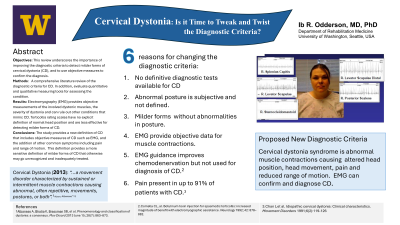
Background and/or Objectives: This review underscores the importance of improving the diagnostic criteria to detect milder forms of cervical dystonia (CD), and to use objective measures to confirm the diagnosis. Cervical dystonia is a syndrome. The diagnosis is based purely on clinical assessment of abnormal posture or movement and there are no specific tests or laboratory studies required. The time to diagnosis is prolonged by years, and milder cases may never meet criteria. Consequently, the condition is underdiagnosed or delayed and subsequently undertreated or mistreated.
Design: A comprehensive literature review of the diagnostic criteria for CD. In addition, evaluate quantitative and qualitative measuring tools for assessing the condition.
Setting : Rehabilitation medicine clinic at tertiary care hospital
Participants : Clinic patient treated for cervical dystonia
Interventions: A comprehensive literature review
Main Outcome Measures: Literature support for adding objective measures to the definition of the cervical dystonia
Results: Electromyography (EMG) provides objective measurements of the involved dystonic muscles, the severity of dystonia and can rule out other conditions that mimic CD. Torticollis rating scales have no explicit definition of normal head position and are less effective for detecting milder forms of CD.
Conclusions: The study provides a new definition of CD that includes objective measures of CD such as EMG, and the addition of other common symptoms including pain and range of motion. This definition provides a more sensitive definition of milder forms of CD that otherwise may go unrecognized and inadequately treated. Cervical dystonia syndrome is abnormal muscle contractions causing symptoms such as altered head position, head movement, pain and reduced range of motion. Electromyography can confirm the diagnosis.

.jpg)