Resident, PGY-4 Ohio State University College of Medicine Columbus, Ohio
Disclosure(s):
Ayush Mehra: No financial relationships to disclose
Case Diagnosis: 75 y.o. female patient with suspected inclusion body myositis
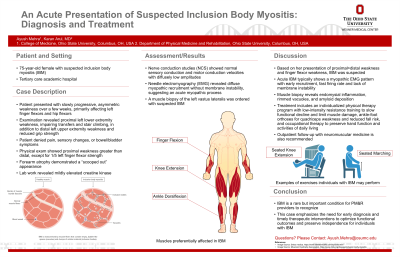
Case Description or Program Description: Patient presented with slowly progressive, asymmetric weakness over a few weeks, primarily affecting left finger flexors and hip flexors. Examination revealed proximal left lower extremity weakness, impairing transfers and stair climbing, and distal left upper extremity weakness, notably reduced grip strength. She denied pain, sensory changes, or bowel/bladder symptoms. Physical exam showed proximal weakness greater than distal, except for 1/5 left finger flexor strength. Forearm atrophy demonstrated a “scooped out” appearance. Lab work revealed mildly elevated creatine kinase.
Setting: Tertiary care academic hospital
Assessment/Results: Nerve conduction studies showed normal sensory conductions and motor conduction velocities with diffusely low amplitudes. Needle electromyography (EMG) revealed diffuse myopathic recruitment without membrane instability, suggesting a myopathic process. A muscle biopsy of the left vastus lateralis was ordered with suspected IBM.
Discussion (relevance): Based on her presentation of proximal>distal weakness and finger flexor weakness, IBM was suspected. Acute IBM typically shows a myopathic EMG pattern with early recruitment and no membrane instability, while muscle biopsy reveals endomysial inflammation, rimmed vacuoles, and amyloid deposition. Treatment includes an individualized physical therapy program with low-intensity resistance training to slow functional decline and limit muscle damage, ankle-foot orthoses for quadriceps weakness and reduced fall risk, and occupational therapy to preserve hand function and activities of daily living. Follow-up with Neuromuscular Medicine may also benefit the patient.
Conclusions: IBM is a rare but important condition for PM&R providers to recognize, emphasizing the need for early diagnosis and timely therapeutic interventions to optimize functional outcomes and preserve independence.

.jpg)