Program Director Mayo Clinic Jacksonville, Florida
Disclosure(s):
Davong Phrathep, DO: No financial relationships to disclose
John Evans, DO: No financial relationships to disclose
Case Diagnosis: Soft tissue foreign body (metallic) in the ulnar aspect of the wrist.
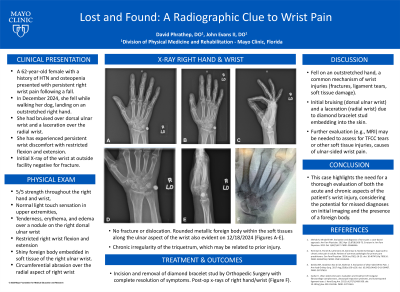
Case Description or Program Description: A 62-year-old female with a history of hypertension and osteopenia presents with persistent right wrist pain following a fall. She was walking her dog when she tripped and landed on an outstretched right hand. She noted bruising over the dorsal ulnar wrist and laceration over the radial wrist. Since the injury, she has experienced ongoing wrist discomfort with restricted flexion and extension. An initial X-ray of the wrist and forearm was negative for fracture.
Setting: Physical Medicine & Rehabilitation Outpatient Clinic
Assessment/Results: The patient had 5/5 strength in the right hand and wrist with normal light touch sensation. Examination showed tenderness, erythema, and edema over a nodule on the right dorsal ulnar wrist, restricted wrist flexion and extension, and a circumferential abrasion on the radial wrist. A shiny foreign body was embedded in the soft tissue of the right ulnar wrist. Imaging showed no fracture or dislocation but revealed a rounded metallic foreign body and chronic triquetral irregularity, possibly from a prior injury. Orthopedic Surgery removed a diamond bracelet stud, leading to complete symptom resolution.
Discussion (relevance): The patient fell on an outstretched hand, a common cause of wrist injuries. This resulted in dorsal ulnar wrist bruising and a radial wrist laceration from a diamond bracelet stud. MRI may be needed to evaluate for TFCC tears or other soft tissue injuries causing ulnar-sided wrist pain.
Conclusions: This case underscores the importance of a comprehensive and radiographical evaluation of both the acute and chronic aspects of wrist injuries, recognizing the potential for missed diagnoses on initial imaging and the presence of a foreign body that may contribute to persistent symptoms.

.jpg)