Resident Physician HonorHealth PM&R Program Scottsdale, Arizona
Disclosure(s):
Kian Bagheri, DO: No financial relationships to disclose
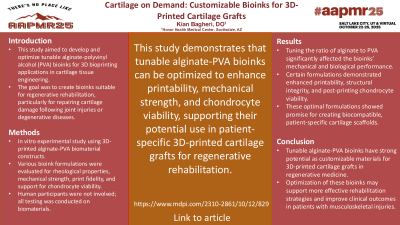
Background and/or Objectives: The study aimed to develop and evaluate tunable alginate-polyvinyl alcohol (PVA) bioinks for 3D printing in cartilage tissue engineering. The goal was to optimize these bioinks for potential use in regenerative rehabilitation, particularly for cartilage repair in patients recovering from joint injuries or degenerative conditions.
Design: Laboratory-based experimental study.
Setting : In vitro study using 3D-printed biomaterials.
Participants : N/A (Utilized biomaterial constructs rather than human participants).
Interventions: Different formulations of alginate-PVA bioinks were tested for their mechanical properties, printability, and ability to support chondrocyte viability, with a focus on applications in rehabilitation and regenerative medicine.
Main Outcome Measures: Bioink rheological properties, print fidelity, mechanical strength, and chondrocyte viability post-printing.
Results: The study found that adjusting the alginate-to-PVA ratio influenced mechanical properties and cell viability, with specific formulations offering improved printability and biological compatibility. These findings suggest potential applications in patient-specific cartilage repair, which could enhance rehabilitation outcomes following joint injuries.
Conclusions: Tunable alginate-PVA bioinks represent a promising tool for 3D-printed cartilage grafts in regenerative rehabilitation. By optimizing bioink properties, researchers can develop more effective cartilage repair solutions, potentially aiding recovery and functional restoration in patients with musculoskeletal injuries.

.jpg)