Medical Student University of California San Diego School of Medicine La Jolla, California
Disclosure(s):
Matthew R. Allen, Other: No financial relationships to disclose
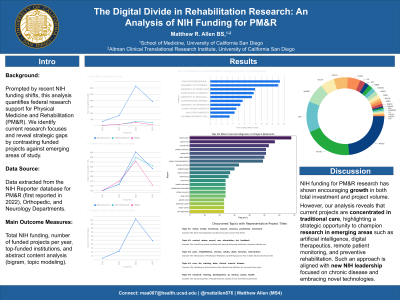
Background and/or Objectives: The allocation of federal research dollars significantly influences a specialty's growth and impact. Understanding recent funding trends for Physical Medicine and Rehabilitation (PM&R) is critical, especially given current NIH reallocations. This study quantifies NIH funding for PM&R and identifies current areas of research focus. This analysis also aims to identify strategic gaps in the current research portfolio by contrasting funded projects against emerging areas of research.
Design: Retrospective observational study.
Setting : Data extracted from the NIH Reporter database for PM&R (first reported in 2022), Orthopedic, and Neurology Departments.
Participants : Not applicable.
Interventions: Not applicable.
Main Outcome Measures: Total NIH funding, number of funded projects per year, top-funded institutions, and abstract content analysis (wordcloud, bigram, topic modeling).
Results: Total PM&R funding increased from $7.50 million in 2022 to $22.10 million in 2023 and a peak of $53.78 million in 2024, indicating a dynamic expansion. Concurrently, the number of NIH-funded PM&R projects increased from 4 in 2022 to 22 in 2023 and 103 in 2024. Leading institutions in PM&R NIH funding include Case Western Reserve University, University of Pittsburgh, and University of Puerto Rico. Project abstracts primarily focus on investigating traditional therapeutic interventions like exercise and physical therapy to improve functional outcomes and quality of life for patients with core PM&R conditions such as stroke, spinal cord injury, and chronic pain.
Conclusions: NIH funding for PM&R research has shown encouraging growth in both total investment and project volume. However, our analysis reveals that current projects are concentrated in traditional care, highlighting a strategic opportunity to champion research in emerging areas such as artificial intelligence, digital therapeutics, remote patient monitoring, and preventive rehabilitation. Such an approach is aligned with new NIH leadership focused on chronic disease and embracing novel technologies.

.jpg)