Program Director Eastern Virginia Medical School PM&R Program Norfolk, Virginia
Disclosure(s):
Kush Shah, BS: No financial relationships to disclose
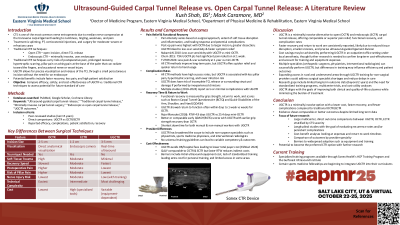
Background and/or Objectives: Carpal tunnel syndrome (CTS) is a common condition that can significantly impair hand function and quality of life. Open and endoscopic carpal tunnel release (OCTR, ECTR) have long been the standard surgical approach, but ultrasound guided carpal tunnel release (UGCTR) has emerged as a minimally invasive alternative. This literature review aims to compare UGCTR with OCTR and ECTR in terms of surgical technique, clinical outcomes, pain relief, functional recovery, cost effectiveness, and provider differences.
Design: Literature review
Setting : Literature search was conducted using PubMed, Google Scholar, and the Cochrane Library with specific keywords. A comprehensive review of these studies analyzing UGCTR, OCTR, and ECTR was conducted focusing on procedural efficacy, complication rates, patient reported outcomes and satisfaction, and potential costs.
Participants : Participants included adult patients diagnosed with CTS who underwent either UGCTR, OCTR, or ECTR, as described in the reviewed studies.
Interventions: UGCTR, OCTR, ECTR
Main Outcome Measures: Pain relief and functional recovery, complication rates, recovery time and return to work, provider differences, and cost-effectiveness
Results: UGCTR demonstrates comparable or superior outcomes in pain relief, functional recovery, and postoperative satisfaction. It offers shorter recovery times, reduced surgical invasiveness, and lower complication rates. UGCTR also allows a broader range of providers, including physiatrists, to perform the procedure, which may improve patient accessibility without sacrificing outcomes. However, cost effectiveness remains uncertain due to varying equipment expenses and provider training disparities.
Conclusions: While further research is needed to evaluate long-term effectiveness, cost efficiency, and provider training implications, UGCTR presents a promising alternative to OCTR and ECTR with potential to become standard of care. Standardized guidelines are required to ensure optimal patient selection and procedural success.

.jpg)