Jovante Dockery, MS in Biomedical Sciences: No financial relationships to disclose
Case Diagnosis: The athlete was diagnosed with a rare distal bicep femoris avulsion injury.
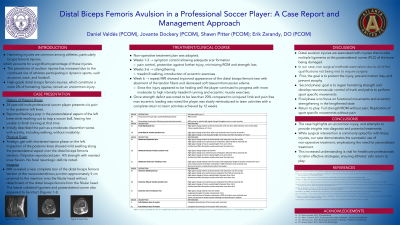
Case Description or Program Description: A 24-year-old male professional soccer player presented with a high-grade tear of the left biceps femoris at the musculotendinous junction. After discussing treatment options with the player, a non-operative approach was chosen. The player was also referred for genetic testing given a previous history of similar injury of the contralateral leg. The player was able to complete a staged return-to-play progression over 12 weeks and was able to return to full participation without restriction.
Setting: Atlanta United FC Soccer Facility and Piedmont Hospital.
Assessment/Results: MRI revealed a near complete tear of the distal biceps femoris tendon at the musculotendinous junction. First, the goal is to protect the injury, prevent motion loss, and prevent atrophy. Second phase: goal is to regain hamstring strength and develop neuromuscular control of trunk and pelvis to perform sport specific movements. The third phase is to focus on functional movements and eccentric strengthening in the lengthened state. The final phase resulted in return to play with full range of motion and no pain.
Discussion (relevance): Distal avulsion injuries are associated with injuries that involve multiple ligaments at the posterolateral corner of the knee being damaged. In our case, non surgical methods were taken due to all of the qualifications not being met to require surgery. This approach resulted in a successful non-operative management of a high-grade distal biceps femoris injury in a professional soccer player.
Conclusions: The case presented highlighted a distal biceps femoris avulsion and attempts to provide insights into diagnosis and alternative treatment options. While surgical intervention is commonly opted for with these injuries, our case demonstrates the successful use of non-operative treatment, emphasizing the need for personalized treatment. This increased understanding is vital for healthcare professionals to tailor effective strategies, ensuring athletes' safe return to play.

.jpg)