Staff Physician Milwaukee VA Medical Center Pewaukee, Wisconsin
Case Diagnosis: A 79-year-old male with episodic migraines and C1 AIS C quadriplegia secondary to C4 vertebral fracture after a fall down a flight of stairs in the setting of severe cervical stenosis, status post C3-7 posterior cervical decompression/fusion.
Case Description or Program Description: Following his injury, the patient experienced insidious onset, progressive neuropathic pain (NP), most profoundly in his bilateral arms. The quality of pain was electrical and burning, described as “grabbing an electric wire fence.” The patient also experienced severe allodynia and hyperalgesia. These sensory disturbances limited the patient’s ability to tolerate nursing cares, such as repositioning, turns, and bathing, as well as electrical stimulation (E-Stim) with occupational therapy. Magnetic resonance imaging of the cervical spine was obtained and ruled out syringomyelia. The patient was treated with scheduled acetaminophen, pregabalin, and duloxetine. Numerous opioid analgesic regimens were trialed either without significant analgesia or with significant sedation. These included oxycodone, tramadol, hydromorphone, and topical buprenorphine. Given the patient’s history of migraines, erenumab, a monthly injectable calcitonin gene-related peptide inhibitor (CGRPi), was started.
Setting: Federal tertiary care hospital.
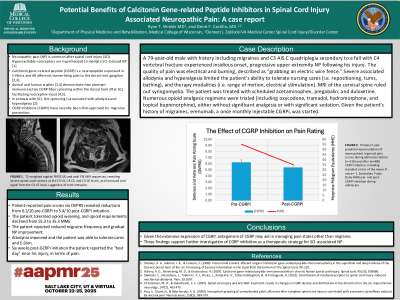
Assessment/Results: Review of patient-reported pain scores using a pain scale for military populations revealed reductions from 6-8/10 to 4-6/10 after CGRPi. The patient reported reduced migraine frequency and gradual NP improvement over 8 weeks. The patient was able to tolerate cares and E-Stim more routinely. Opioid use declined from 55.3 to 35.3 morphine milligram equivalents. Six weeks post-GCRPi initiation the patient reported the “best day” since his injury, in terms of pain.
Discussion (relevance): This is the first reported case, to our knowledge, of improvements in spinal cord injury (SCI)-related NP associated with CGRPi for migraine. Animal and human studies have demonstrated aberrant CGRP axonal sprouting following SCI – in animals, this sprouting is associated with allodynia and hyperalgesia.
Conclusions: Antagonism of CGRP may be beneficial in managing pain states other than migraine.

.jpg)