Attending Physician - Sports Medicine University of Washington Lombard, Illinois
Disclosure(s):
Katherine Lumetta, MD, MEd: No financial relationships to disclose
Background and/or Objectives: To compare training methods between swimmers with and without hip injuries.
Design: A survey link was emailed to coaches of college and club swimming teams nationwide. Swimmers completed a self-administered questionnaire covering their demographics, training profiles, and injury history. Participants reported their highest level of competition and any past hip injuries, including medical diagnoses. Independent t-tests compared training methods between swimmers with and without hip injuries, while binary logistic regression assessed the predictive relationship between training methods and hip injury occurrence.
Setting : Participants completed an online survey questionnaire on their own time.
Participants : N=285 competitive swimmers between the ages of 12-30 years old.
Interventions: Comparison of training methods and swimmer profiles between swimmers with and without hip injuries.
Main Outcome Measures: The primary outcome was the difference in training methods between swimmers with and without hip injuries. A secondary analysis examined the predictive relationship between specific training methods or swimming profiles and the occurrence of hip injury.
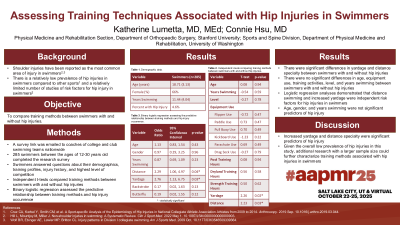
Results: 4.6% of participants (n=13) reported a hip injury. There was a significant difference in yardage (mean difference: 0.37; t-test: 2.26; p=0.02) and distance (mean difference: 0.49; t-test: 2.23; p=0.03) between swimmers with and without hip injuries. There were no significant differences in age, equipment use, training activities, level, and years swimming between swimmers with and without hip injuries. Logistic regression analyses demonstrated that distance swimming (OR: 2.29; 95% CI: 1.06 to 4.97; p=0.04) and increased yardage (OR: 2.76; 95% CI: 1.13 to 6.75; p=0.03) were independent risk factors for hip injuries in swimmers. Age, gender, and years swimming were not significant predictors of hip injury.
Conclusions: Increased yardage and distance were significant predictors of hip injury in swimmers. Given the overall low prevalence of hip injuries in this study, additional research with a larger sample size could further characterize training methods associated with hip injuries in swimmers.

.jpg)