Resident Physician NYMC Metropolitan Hospital Istanbul, New York
Disclosure(s):
Ozan Soyer, MD: No financial relationships to disclose
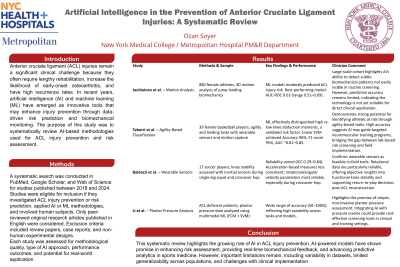
Background and/or Objectives: Anterior cruciate ligament (ACL) injuries are a major concern since they require lengthy recovery periods, increase the incidence of osteoarthritis, and have high recurrence rates. The development of machine learning (ML) and artificial intelligence (AI) has brought data-driven, automated techniques for predicting and preventing ACL injuries. This study systematically reviews AI-based methodologies for ACL injury prevention.
Design: Systematic review
Setting : PubMed, Google Scholar and Web of Science
Participants : This study included 18 studies published between 2018 and 2024, focusing on AI/ML for ACL injury prevention, risk prediction, and biomechanical analysis.
Interventions: The included studies were assessed according to their real-world application, performance measures, AI approaches, and methodological quality.
Main Outcome Measures: This study assesses the predictive accuracy of AI-based ACL risk models, the efficacy of AI-driven motion monitoring, and the reliability of wearable sensors.
Results: Jauhiainen et al. used 3-dimensional motion analysis to study 880 female athletes and found that ML models had modest predictive accuracy, with the best-performing model reaching 0.63 and AUC-ROC values ranging from 0.51 to 0.69. Furthermore, a study that used machine learning to classify agility-based movements successfully distinguished between high and low knee abduction moments linked to the risk of ACL injuries, achieving AUC-ROC values between 0.81 and 0.85. Baldazzi et al. found intraclass correlation between 0.29 and 0.84 in their evaluation of wearable sensors' reliability for knee stability analysis. While acceleration-based parameters were less reliable, rotational movements demonstrated the highest consistency, especially during the crossover hop test. Using AI-based plantar pressure analysis, Li et al. demonstrated classification accuracy ranging from 50% to 100%.
Conclusions: AI-powered models have shown promising results in ACL injury prevention by improving risk assessment, real-time biomechanical feedback, and predictive analytics. However, issues remain in terms of data uniformity, model generalizability, and real-world installation. Future research should concentrate on incorporating AI into clinical sports medicine to improve injury prevention techniques.

.jpg)