PGY-3 Family Medicine Resident Detroit Medical Cneter Detroit, Michigan
Disclosure(s):
Dhiraj Tadikamalla, BS: No financial relationships to disclose
Case Diagnosis: Polymyalgia rheumatica (PMR) is a prevalent systemic inflammatory condition observed primarily in white females over 50.
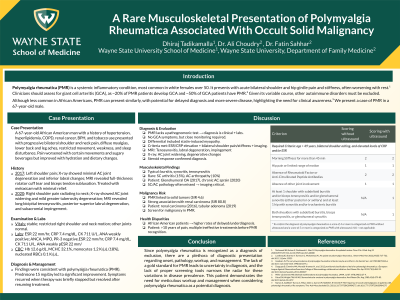
Case Description or Program Description: The patient is a 67-year-old African American male who presented with progressive bilateral shoulder joint and neck pain. The patient reported restricted movement and diffuse muscle aches in the lower back, flank, and bilateral legs. Imaging showed minimal acromioclavicular joint and inferior glenoid labrum degeneration, long bicipital tenosynovitis, and subacromial impingement. Considering complaints, disease analysis, and all other clinical findings, the patient was diagnosed and treated as polymyalgia rheumatica.
Setting: In an outpatient clinic, a diagnosis of polymyalgia rheumatica is based on clinical presentation and supportive laboratory findings.
Assessment/Results: Clinically, polymyalgia rheumatica presents with acute onset of bilateral shoulder pain and stiffness, as well as concomitant hip girdle pain and stiffness, that worsens with rest. There is no pathognomonic test or diagnostic criteria, hence patients can present with variable manifestations of the disease.
Discussion (relevance): Comprehensive diagnostic criteria, including elevated erythrocyte sedimentation rate (ESR) and C-reactive protein (CRP) levels, were applied alongside the characteristic clinical presentation of bilateral shoulder pain and stiffness. Differential diagnoses, such as rheumatoid arthritis and statin-induced myopathy, were ruled out through negative antibody tests (ANCA, MPO, PR-3) and a statin holiday. Highlighted associations of PMR found in this patient include the presence of sternoclavicular arthropathy, correlation with occult solid malignancy, lack of giant cell arteritis symptoms, and underrecognition in African American populations.
Conclusions: Since polymyalgia rheumatica is recognized as a diagnosis of exclusion, there are a plethora of diagnostic presentations regarding onset, pathology, workup, and management. The lack of a gold standard for PMR leads to uncertainty in diagnosis, and the lack of proper screening tools narrows the radar for these variations in disease prevalence. This patient demonstrates the need for meticulous workup and management when considering polymyalgia rheumatica as a potential diagnosis.

.jpg)