Physician Tufts Medical Center Boston, Massachusetts
Disclosure(s):
Lillian Sidky, BS: No financial relationships to disclose
Shane Davis, MD: No financial relationships to disclose
Case Diagnosis: Hereditary neuropathy with liability to pressure palsies in a collegiate athlete
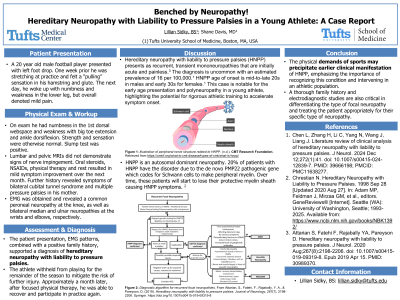
Case Description or Program Description: A 20 year old male football player presented to sports medicine clinic with left foot drop. One week prior, he was stretching at practice and felt a “pulling” sensation in his left hamstring and glute. The next day, he woke up with numbness and weakness in the left lower leg. Pain was mild. On exam of left lower extremity, he had numbness in the 1st dorsal webspace and weakness with big toe extension and ankle dorsiflexion. Strength and sensation were otherwise normal. Slump test was positive. Lumbar and pelvic MRIs did not demonstrate signs of nerve impingement. Despite treatment with oral steroids, NSAIDs, physical therapy, and rest, symptom improvement was limited. Further history revealed symptoms of bilateral cubital tunnel syndrome and a family history of multiple pressure palsies in his mother. EMG was obtained and revealed a common peroneal neuropathy at the knee, as well as bilateral median and ulnar neuropathies at the wrists and elbows respectively.
Setting: Sports Medicine Clinic
Assessment/Results: The EMG patterns, combined with a positive family history, supported a diagnosis of hereditary neuropathy with liability to pressure palsies (HNPP). The athlete made a full recovery after 2 months, at which point he was cleared for football activity.
Discussion (relevance): HNPP is uncommon, with an estimated prevalence of 16 per 100,000. Age of onset is commonly mid-to-late 20s in males and early 30s for females.1 This case highlights the importance of keeping a broad differential when caring for athletes.
Conclusions: HNPP should be considered in athletes presenting with pressure-induced neuropathies after excluding more common anatomic causes. The physical demands of sports may precipitate clinical manifestation, emphasizing the importance of recognizing this condition and intervening in an athletic population.

.jpg)








.jpg "Lillian Sidky, BS photo")