Zeeshan Tayeb, MD: No relevant disclosure to display
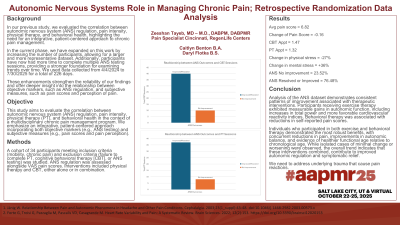
Background and/or Objectives: This study aims to evaluate the correlation between autonomic nervous system (ANS) regulation, pain intensity, physical therapy (PT), and behavioral health in the context of a multidisciplinary chronic pain management program. We emphasize an integrative, patient-centered approach incorporating both objective markers (e.g., ANS testing) and subjective measures (e.g., pain scores and pain perception).
Design: A cohort of 17 participants meeting inclusion criteria (mobility, chronic pain) and exclusion criteria (failure to complete PT, cognitive behavioral therapy [CBT], or ANS testing) was studied. ANS regulation was assessed alongside VAS pain scores. Interventions included physical therapy and CBT, either alone or in combination.
Setting : ANS Testing, Physical Therapy, and Cognitive Behavior Therapy took place in the physician's practice.
Participants : A cohort of 17 participants meeting inclusion criteria (mobility, chronic pain) and exclusion criteria (failure to complete PT, cognitive behavioral therapy [CBT], or ANS testing) was studied.
Interventions: ANS Testing, Physical Therapy, Cognitive Behavioral Therapy, or a combination of both therapies.
Main Outcome Measures: The change in pre and post VAS scores and ANS results.
Results: 59% of participants qualified and completed the study. Of these, 60% demonstrated improved or resolved ANS findings, while 40% showed no improvement. Resolved ANS dysfunction was most associated with physical therapy and exercise. The combination of PT and CBT was most prevalent among those with improved ANS findings. However, CBT, when combined with physical therapy and exercise, appeared to increase somatization from the patient's perspective, as indicated by patient-reported VAS scores.
Conclusions: Physical therapy plays a significant role in improving and potentially resolving ANS dysfunctions. Additionally, CBT in conjunction with physical therapy and exercise can further enhance ANS regulation but may lead to increased somatization. Further longitudinal studies are necessary to fully understand the predictive value of ANS testing in chronic pain management and to optimize treatment protocols.

.jpg)