Victor Do, B.S.: No financial relationships to disclose
Background and/or Objectives:
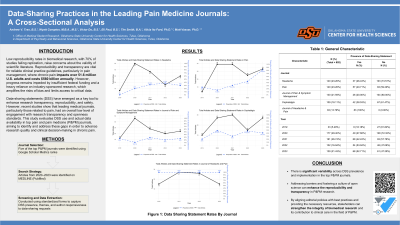
Background: Reproducibility and transparency are essential to high-quality biomedical research, yet data-sharing practices remain inconsistent across pain and pain management (P&PM) journals. Data-sharing statements (DSS) promote accessibility and accountability but are variably adopted due to differing journal policies.
Objective: To assess the prevalence, characteristics, and practical implementation of DSS in leading P&PM journals.
Design: Cross-sectional analysis of articles published in the top 5 P&PM journals. Hierarchical logistic regression assessed factors influencing DSS inclusion. Thematic analysis evaluated DSS content to identify barriers. Corresponding authors of articles with "data available upon request" were contacted to assess willingness to share.
Setting : Top 5 peer-reviewed P&PM journals selected by impact factor and relevance.
Participants : Published research articles (n = 602); corresponding authors (n = 128) of articles indicating data availability upon request.
Interventions: Not applicable.
Main Outcome Measures: Prevalence of DSS, associated characteristics (e.g., funding source, study design), barriers to sharing, and author responsiveness.
Results: Of 602 articles, 245 (40.7%) included a DSS. The Journal of Headache and Pain had the highest inclusion rate. Industry-funded studies were more likely to include a DSS; study design had no significant effect. DSS prevalence has increased over time. Common barriers included conditional availability and reliance on a data gatekeeper. Of 128 authors contacted, 41 responded: 40.91% agreed to share de-identified data, 29.55% would share under conditions, and 22.73% declined.
Conclusions: Substantial variability in DSS implementation persists across P&PM journals. Adoption of clear, standardized DSS policies—modeled after leading journals—may enhance transparency, reproducibility, and collaboration in the field.

.jpg)