Clinical Associate Professor Stanford University School of Medicine Stanford, California
Disclosure(s):
Katherine Lumetta, MD, MEd: No financial relationships to disclose
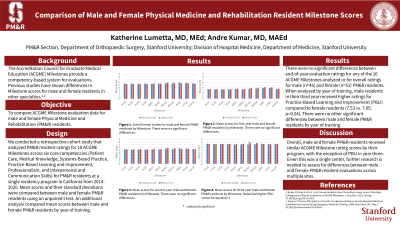
Background and/or Objectives: To compare Accreditation Council for Graduate Medical Education (ACGME) Milestone evaluation data for male and female Physical Medicine and Rehabilitation (PM&R) residents.
Design: We conducted a retrospective cohort study that analyzed PM&R resident ratings for 10 ACGME Milestones across 6 domains (Patient Care, Medical Knowledge, Systems-Based Practice, Practice-Based Learning and Improvement, Professionalism, and Interpersonal and Communication Skills). Mean scores and their standard deviations were compared between male and female PM&R residents using an unpaired t test. An additional analysis compared mean scores between male and female PM&R residents by year of training.
Setting : A single PM&R residency program at an academic center in California.
Participants : N=96 PM&R residents in residency training from 2014-2020.
Interventions: Comparison of mean scores.
Main Outcome Measures: Our primary outcome was the difference in the mean end-of-the-year Milestone scores between male and female PM&R residents across each ACGME Milestone domain. Secondary analyses included comparisons by training year.
Results: There were no significant differences between end-of-year evaluation ratings for any of the 10 ACGME Milestones analyzed or for overall ratings for male (n=45) and female (n=51) PM&R residents. When analyzed by year of training, male residents in their third year received higher ratings for Practice-Based Learning and Improvement (PBLI) compared to female residents (7.53 vs. 7.05; p=0.04). There were no other significant differences between male and female PM&R residents by year of training.
Conclusions: Overall, male and female PM&R residents received similar ACGME Milestone rating scores by their program, with the exception of PBLI in year 3. Given this was a single center, further research is needed to assess for differences between male and female PM&R resident evaluations across multiple sites.

.jpg)