Assistant Professor Medical College of Wisconsin Milwaukee, Wisconsin
Disclosure(s):
Alexandra Frank, MD: No financial relationships to disclose
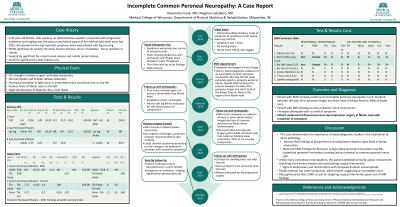
Case Diagnosis: A 43 y/o female presents with insidious left lateral ankle and foot numbness and is found to have a common peroneal neuropathy.
Case Description or Program Description: Common Peroneal Neuropathy is one of the most encountered mononeuropathies and is typically caused by compression of the nerve at the fibular head. This case is being presented due to predominantly axonal involvement and the need for surgical intervention.
Setting: A 43-year-old female, who works as an administrative assistant, presented with progressive numbness and tingling over the dorsum and lateral aspect of her left foot and ankle since July 2023. She denied trauma but reported symptoms were exacerbated with leg-crossing.
Assessment/Results: Physical exam showed sensory deficits in the distribution of the superficial peroneal nerve and tenderness over the fibular head. Electrodiagnostic testing confirmed incomplete common peroneal neuropathy, primarily axonal in nature, localized to the take-off between peroneus longus and short head of biceps femoris, near the fibular neck. Imaging ruled out structural compression of the nerve. The patient underwent conservative treatment with physical therapy and positional modifications, with minimal improvement. Given persistent symptoms, surgical decompression of the common peroneal nerve was performed in October 2023. Postoperatively, she reported improved sensation and symptom relief.
Discussion (relevance): This case demonstrates the importance of electrodiagnostic studies in the localization of nerve pathology. Unlike many compression neuropathies, this patient exhibited primarily axonal involvement, indicating more severe disease and necessitating surgical intervention. Severity was notable given lack of lesions on imaging. EMG was crucial in localizing areas for surgical intervention.
Conclusions: This case highlights the complex nature of diagnosing, localizing, and managing peroneal neuropathy. It demonstrates that surgical decompression can be an effective treatment for persistent symptoms, even in cases without a clear structural compression of the nerve on imaging. Further research on long-term outcomes is warranted.

.jpg)