Assistant Professor, Assistant Program Director Mt Sinai School of Medicine Oceanside, New York
Disclosure(s):
Ruben Castro, MD: No financial relationships to disclose
Case Diagnosis: 54-year-old male with POEMS syndrome
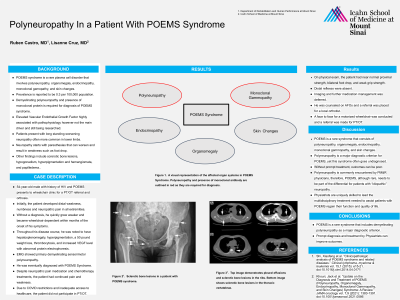
Case Description or Program Description: 54-year-old male with history of HIV and POEMS presents to wheelchair clinic for a PT/OT referral and orthosis. Initially, the patient developed distal weakness, numbness and neuropathic pain in all extremities. Without a diagnosis, he quickly grew weaker and became wheelchair dependent within months of the onset of his symptoms. Throughout his disease course, he was noted to have hepatosplenomegaly, hyperpigmentation, a 50 pound weight loss, thrombocytosis, and increased VEGF level with abnormal protein electrophoresis. EMG showed primary demyelinating sensorimotor polyneuropathy. He was eventually diagnosed with POEMS Syndrome. Despite neuropathic pain medication and chemotherapy treatments, the patient had continued pain and weakness. Due to COVID restrictions and inadequate access to healthcare, the patient did not participate in PT/OT.
Setting: Outpatient wheelchair clinic
Assessment/Results: On physical exam, the patient had near normal proximal strength, bilateral foot drop, and weak grip strength. Distal reflexes were absent. Imaging and further medication management was deferred. He was counseled on AFOs and a referral was placed for a local orthotist. A face to face for a motorized wheelchair was conducted and a referral was made for PT/OT.
Discussion (relevance): POEMS is a rare syndrome that consists of polyneuropathy, organomegaly, endocrinopathy, monoclonal gammopathy, and skin changes. Polyneuropathy is a major diagnostic criterion for POEMS, yet this syndrome often goes undiagnosed. Without prompt treatment, outcomes can be poor. Polyneuropathy is commonly encountered by PM&R physicians, therefore, POEMS, although rare, needs to be part of the differential for patients with “idiopathic” neuropathy. Physiatrists are uniquely skilled to lead the multidisciplinary treatment needed to assist patients with POEMS regain their function and quality of life.
Conclusions: POEMS is a rare syndrome that includes demyelinating polyneuropathy as a major diagnostic criterion. Prompt diagnosis and treatment by Physiatrists can improve outcomes.

.jpg)