Medical Student at Noorda College of Osteopathic Medicine. Noorda College of Osteopathic Medicine Layton, Utah
Disclosure(s):
Samuel T. Christiansen: No financial relationships to disclose
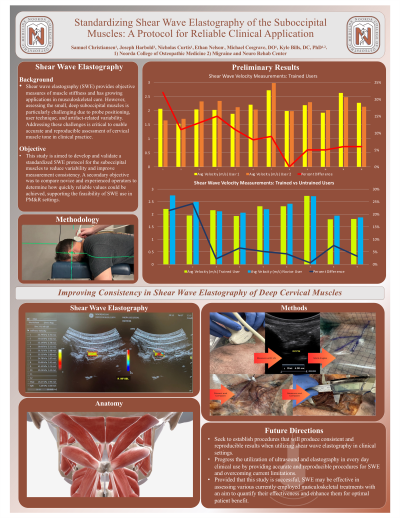
Background and/or Objectives: Shear wave elastography (SWE) offers objective assessment of muscle stiffness but is limited by variability, especially in small, deep cervical muscles. This study aimed to develop and validate a standardized SWE protocol for the suboccipital muscles to minimize positioning and artifact-related error. A secondary objective was to evaluate how quickly both novice and experienced users could achieve reliable measurements, supporting broader use in PM&R settings.
Participants : Healthy adult volunteers, with no known cervical or spinal pathology.
Interventions: Participants were positioned prone on a specialized table to reduce tension. A convex transducer was aligned longitudinally along suboccipital muscle fibers with minimal, consistent pressure. Multiple SWE measurements were captured per muscle. Two novice and two experienced operators independently performed scans using the protocol.
Main Outcome Measures: Primary outcomes included intra-user and inter-user reliability of SWE-derived stiffness values (shear wave velocity, Young’s modulus) and number of scans required to achieve consistency.
Results: Novices achieved inter-user reliability after the first scan and intra-user reliability by the fourth, with only one outlier thereafter. Experienced users—one SWE-proficient, one unfamiliar with SWE—achieved reliable intra- and inter-user measurements by the third scan. The standardized protocol reduced variability and improved reproducibility regardless of experience level.
Conclusions: This validated protocol enables accurate, reproducible SWE assessment of suboccipital muscles and can be adopted rapidly by clinicians with varying ultrasound experience. It supports objective evaluation of cervical muscle tone and has potential for broader application across the spine, aiding in the diagnosis, treatment planning, and monitoring of spine-related pain and dysfunction in PM&R practice.

.jpg)








.jpeg.jpg "Samuel T. Christiansen photo")