Resident Physician Broward Health Boca Raton, Florida
Disclosure(s):
Arian Khoshgowari, DO: No financial relationships to disclose
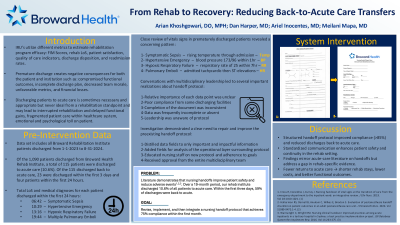
Background and/or Objectives: Rehabilitation program efficacy is typically measured using various indicators, including FIM scores, LOS, quality of care, discharge disposition, and readmission rates. Premature discharge to acute care negatively impacts patient outcomes, institutional metrics, and care continuity. A retrospective review identified a high proportion of early discharges, and limited use of handoff protocols, suggesting the need for improved preadmission processes.
Design: Quality improvement initiative with retrospective review followed by protocol development, implementation, and prospective monitoring.
Setting : Broward Rehabilitation Institute
Participants : All inpatients discharged from the rehabilitation institute between January 1, 2023, and August 31, 2024 (n = 1,090). A subset of 115 patients discharged back to acute care were analyzed, with special focus on the 23 patients discharged within the first 3 days.
Interventions: Development and implementation of a nursing handoff protocol, completed prior to patient transfer to the rehabilitation unit. The protocol included critical data points (e.g., vital signs, labs, barriers to care), and operational elements (e.g., timing, staff compliance, communication pathways). Staff were educated, and leadership across disciplines provided feedback to refine the protocol.
Main Outcome Measures: Compliance with nursing handoff protocol, Completeness of handoff documentation, Frequency and timing of discharges back to acute care, Identification of operational barriers and trends.
Results: 10.6% of total discharges were to acute care. 59% of early discharges returned to acute care within the first 3 days of admission, with 4 readmitted within 24 hours. Vital sign abnormalities were present upon admission in many of these early discharges. Nursing handoff protocol was implemented on January 21, 2025. Post-implementation, adherence to the greater than 80% following the first three months of implementation.
Conclusions: A standardized nursing handoff protocol improved communication prior to patient arrival, helped identify early signs of instability, and has the potential to reduce premature discharges to acute care. Initial implementation showed high adherence with reduction in back to acute care transfers.

.jpg)