Audrey V. Adler, MD: No financial relationships to disclose
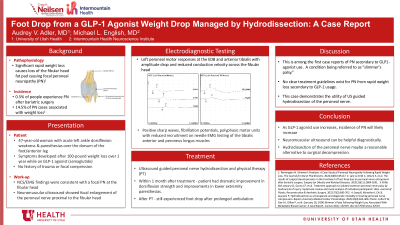
Case Diagnosis: 46-year-old female with focal peroneal neuropathy (PN) following dramatic weight-loss secondary to GLP1-agonist managed by hydrodissection.
Case Description or Program Description: Patient presented with acute left ankle dorsiflexion weakness and paresthesias over the dorsum of the foot/anterior leg after 100-pound weight loss over 1 year while on semaglutide. There was otherwise no history of trauma or focal compression. NCS/EMG findings were consistent with a focal PN at the fibular head. Ultrasound revealed fascicle drop out and mild focal enlargement of the peroneal nerve proximal to the fibular head. Patient underwent peroneal nerve hydrodissection and physical therapy (PT).
Setting: Outpatient PM&R Clinic
Assessment/Results: Within 1 month, patient had dramatic improvement in dorsiflexion strength and improvements in ankle pain. Upon physical therapy discharge, she still experienced foot drop during prolonged ambulation.
Discussion (relevance): Patients with significant rapid weight loss can develop focal PN due to loss of the fat pad surrounding the fibular head causing peroneal nerve entrapment. There lacks clear treatment guidelines regarding management; options range from conservative approaches to surgical options. Some research supports the role of early surgical decompression for better outcomes in motor recovery. This case is among the early reports of PN secondary to GLP1-agonist and is the first utilizing hydrodissection to treat focal PN. Prior research has identified the role of hydrodissection for the successful management of carpal and cubital tunnel syndromes. A case study described hydrodissection as a therapeutic and diagnostic modality for PN because it provided symptomatic relief and early identification of a fibrous band promoting earlier and targeted surgical decompression.
Conclusions: As GLP-1 agonist usage increases, we expect the incidence of PN to rise. Hydrodissection represents a promising diagnostic and therapeutic technique with potential benefits including symptom relief or earlier identification of candidates for whom would benefit from surgical decompression. Additional research into the effectiveness of hydrodissection for focal PN is necessary.

.jpg)