Pain Management Physician Faruk Razzak D.O. EAST MEADOW, New York
Disclosure(s):
Kyle F. Cullin, DO: No financial relationships to disclose
Case Diagnosis: Complex Regional Pain Syndrome from Dogfish Spine Envenomation.
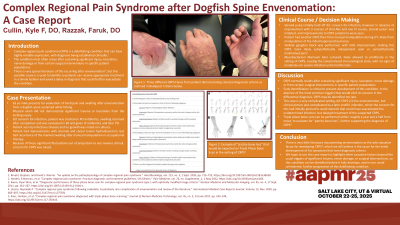
Case Description or Program Description: 62 yo male presents for evaluation of hand pain and swelling after envenomation from dogfish spine. Physical exam did not demonstrate significant trauma/laceration injury. D/t infection concern, patient started PO antibiotics, swelling returned after completion, later evaluated in ER, given IV antibiotics. Patient seen by Infectious Disease and no growth was noted on cultures. Patient had improvements with carpal tunnel hydrodissection, but had recurrence of marked swelling after manual manipulation in OT. Because of these significant fluctuations out of proportion to any noxious stimuli, concern for CRPS was raised.
Setting: Outpatient
Assessment/Results: CRPS 2/2 envenomation
Discussion (relevance): CRPS normally results after sustaining significant injury, laceration, nerve damage or from certain surgical interventions in specific patient populations. Early identification is critical to prevent development of this condition. In the absence of the most common triggers that would elicit its concern in the differential diagnosis, CRPS may be identified too late. This case would have been strictly induced by envenomation d/t lack of significant trauma or positive culture for any specific bacteria, such as mycobacterium marinum, that would be suspected from wounds sustained from marine environments. Patient will be followed throughout flareups to monitor for response to only steroids and/or stellate ganglion blocks. Triple phase bone scan can be performed a year and a half from onset, to evaluate for patchy bone loss, further supporting the diagnosis of CRPS. Bee Venom pharmacopuncture is currently being considered to address the allodynia of patient’s likely diagnosis of CRPS.
Conclusions: There is very little literature documenting envenomation as the sole causative factor for developing CRPS. We hope to use this case report to highlight other causative factors beyond the usual triggers so this condition can be identified before it fully develops, and in turn avoid development of this debilitating condition.

.jpg)