Medical director, Milne Institute, Gaylord Hospital Gaylord Hospital Wallingford, Connecticut
Disclosure(s):
Patrick Monico, DO: No financial relationships to disclose
David Rosenblum, MD: No financial relationships to disclose
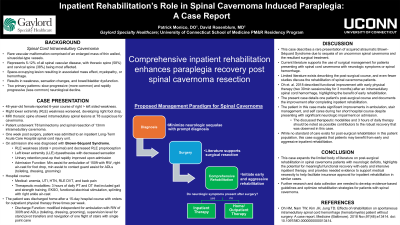
Case Diagnosis: This case report describes a 48-year-old woman with a 13-mm intramedullary cavernous malformation at the T8 level who underwent surgical resection followed by acute inpatient rehabilitation.
Case Description or Program Description: Preoperatively, the patient experienced eight years of progressive right lower extremity weakness as well as impaired balance and proprioception. Following T8 laminectomy and lesion resection, she was admitted to acute inpatient rehabilitation where her impairments included decreased balance and proprioception, right lower extremity weakness, and left lower extremity decreased sensation in a Brown-Séquard pattern.
Setting: Acute inpatient rehabilitation
Assessment/Results: The rehabilitation program focused on addressing these deficits through a multidisciplinary approach including physical therapy, occupational therapy, and medical management. Specifically, modalities utilized include high intensity gate training, zero G, and a lower extremity air cast. By discharge from acute rehabilitation, the patient demonstrated significant functional improvement, achieving ambulation of 300 feet with an assistive device and the ability to traverse stairs.
Discussion (relevance): This case adds to the growing body of evidence suggesting symptom improvement following surgical cavernoma resection and uniquely highlights the rehabilitation course as a significant driver of quick and robust recovery. Existing literature on spinal cavernoma resections largely supports symptom improvement post-surgery but fails to address whether acute inpatient rehabilitation contributed to post-surgical outcomes. This case details the benefit of inpatient rehabilitation in this rare disease and addresses the need for further investigation into the combined benefit of a surgical and rehabilitation approach to patient care.
Conclusions: In conclusion, this case report contributes to the limited literature on rehabilitation course and outcomes data for spinal cavernoma patients and underscores the potential for functional recovery through a targeted, multidisciplinary rehabilitation approach. Further research is needed to establish evidence-based guidelines for rehabilitation of patients with this rare condition.

.jpg)