Chair The Ohio State University Wexner Medical Center Columbus, Ohio
Disclosure(s):
Pranav Bollavaram, MD: No financial relationships to disclose
Whitney Luke, MBA, MD: No financial relationships to disclose
Case Diagnosis: Radiation induced spinal accessory nerve palsy.
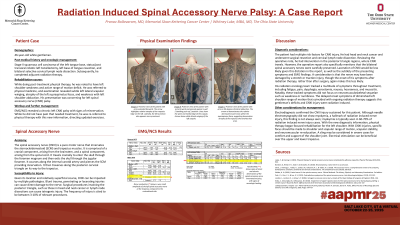
Case Description or Program Description: A 46-year-old white gentleman was diagnosed with stage II squamous cell carcinoma of the left tongue base. After evaluation by otolaryngology, he underwent transoral robotic left tonsillectomy, left base of tongue resection, and bilateral selective lymph node dissection. One month later, he completed adjuvant radiation therapy. Following this, he began physical and occupational therapy focused on bilateral shoulder strengthening, neck range of motion, and lymphedema management. In therapies, he was noted to have left shoulder weakness and range of motion deficiencies and was thus referred to an outpatient oncology rehabilitation clinic.
Setting: Outpatient cancer rehabilitation clinic.
Assessment/Results: Physical examination revealed lateral scapular winging. He had painless atrophy of the left supraspinatus fossa and periscapular region, with associated weakness with left shoulder abduction. Electromyography and nerve conduction studies revealed a chronic left spinal accessory nerve (CN XI) neuropathy with signs of reinnervation. He was re-referred to therapy with this new diagnostic information.
Discussion (relevance): While CN XI injury is possible for head and neck cancer patients, the injury etiology is variable. In this case, based on the patient history and timing of symptoms, his neuropathy is likely radiation induced. While CN XI can physically be disrupted during neck dissection, our patient's operative report notes that the nerve was carefully preserved. The radiation oncology team tracked multiple radiation-induced symptoms, none of which were neurological or musculoskeletal sequelae. Accurate diagnosis helped direct his therapy management and recovery course. This case highlights the multidisciplinary approach to cancer rehabilitation and the use of various diagnostic tools in rehabilitative care.
Conclusions: Though radiation induced nerve injuries are known to occur, early involvement of therapies and physical medicine can identify and manage deficits, such that patients can continue to be functional through their cancer treatment.

.jpg)