Assistant Professor Washington University School of Medicine
Disclosure(s):
Jonathan Bauer, MD: No financial relationships to disclose
Case Diagnosis: 39 y.o. female with left anterior hip, groin pain originally thought to be adductor strain revealed to be pyomyositis with further workup.
Case Description or Program Description: The patient presented to the orthopedic clinic with left anterior hip and groin pain. The likely injurious event occurred four days prior when she fell helping her dog up the stairs; she states she impacted onto her anterior hip, she was unsure if she twisted her hip as well. Pain was localized to her groin and anterior medial thigh with the patient denying any soft tissue swelling or bruising. The injury worsened 2 days after the initial event without any additional inciting incident, and the patient was no longer able to ambulate without the help of axillary crutches. Physical exam was notable for the most specific tenderness located over the adductors. Appropriate x-rays were ordered of the pelvis which revealed no acute fracture. Patient was referred to physical therapy and started on meloxicam and Flexeril. The following day the patient sent an image in MyChart with new swelling and bruising tracking down the leg; she reported to the ED later that day due to pain and at physician urging.
Setting: Washington University Orthopedic Injury Clinic
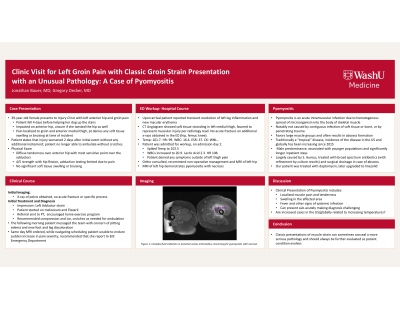
Assessment/Results: A CT angiogram completed found evidence of soft tissue stranding within the left medial thigh. Upon admission, orthopedics was consulted and recommended MRI of left hip. The MRI showed pyomyositis with necrosis. A ultrasound guided IR left thigh fluid collection was obtained, and patient was started on appropriate antibiotics. Further developments will be discussed.
Discussion (relevance): This is a unique case of pyomyositis in the left femur that initially presented as a classic picture groin adductor strain in a clinic patient.
Conclusions: Classic presentations of muscle strain can sometimes hide more serious conditions and should be further evaluated as patient condition changes.

.jpg)