Medical Student University of Central Florida College of Medicine Orlando, Florida
Disclosure(s):
Jason Liu, Other: No financial relationships to disclose
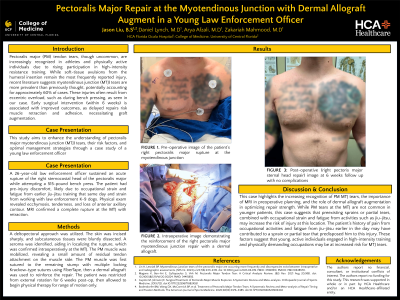
Case Diagnosis: A 26-year-old law enforcement officer sustained an acute rupture of the sternocostal head of the pectoralis major while attempting a 515-pound bench press.
Case Description or Program Description: The patient had pre-injury discomfort, likely due to occupational strain and fatigue from earlier jiu-jitsu training that same day and straiin from working with law enforcement K-9 dogs.. Physical exam revealed ecchymosis, tenderness, and loss of anterior axillary contour. MRI confirmed a complete rupture at the MTJ with retraction.
Setting: Recreation center
Assessment/Results: A deltopectoral approach was utilized. The skin was incised sharply, and subcutaneous tissues were bluntly dissected. A seroma was identified, aiding in localizing the rupture, which was confirmed intraoperatively at the MTJ. The PM muscle was mobilized, revealing a small amount of residual tendon attachment on the muscle side. The PM muscle was first sutured to the remaining stump with multiple locking krackow-type sutures with FiberTape, then a dermal allograft was used to reinforce the repair. The patient was restricted from external rotation for 6 weeks post-op, then allowed to begin physical therapy for range of motion only.
Discussion (relevance): This case highlights the increasing recognition of PM MTJ tears, the importance of MRI in preoperative planning, and the role of dermal allograft augmentation in optimizing repair strength.
Conclusions: While PM tears at the MTJ are not common in younger patients, this case suggests that preexisting sprains or partial tears, combined with occupational strain and fatigue from activities such as jiu-jitsu, may increase the risk of injury at this location. The patient’s history of pain from occupational activities and fatigue from jiu-jitsu earlier in the day may have contributed to a sprain or partial tear that predisposed him to this injury. These factors suggest that young, active individuals engaged in high-intensity training and physically demanding occupations may be at increased risk for MTJ tears.

.jpg)