Attending Physician PM&R VAH San Juan Trujillo Alto, PR
Disclosure(s):
Asdrubal Rivera, MD: No financial relationships to disclose
Case Diagnosis: Right Proximal Femur Benign Osteoblastoma
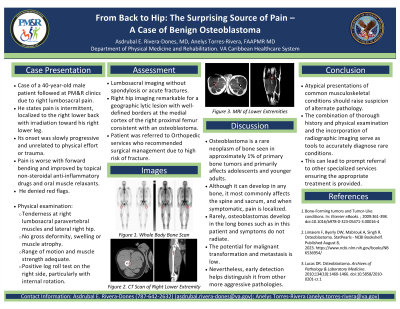
Case Description or Program Description: Case of a 40-year-old male patient followed at PM&R clinics due to right lumbosacral pain. He states pain is intermittent, localized to the right lower back with irradiation toward his right lower leg. Its onset was slowly progressive and unrelated to physical effort or trauma. Pain is worse with forward bending and improved by topical non-steroidal anti-inflammatory drugs and oral muscle relaxants. He denied red flags.
Setting: Outpatient clinics
Assessment/Results: Physical exam remarkable for tenderness at right lumbosacral paravertebral muscles and lateral right hip. No gross deformity, swelling or muscle atrophy. Range of motion and muscle strength adequate. Positive log roll test on the right side, particularly with internal rotation. Lumbosacral imaging without spondylosis or acute fractures. Right hip imaging remarkable for a geographic lytic lesion with well-defined borders at the medial cortex of the right proximal femur consistent with an osteoblastoma. Patient was referred to Orthopedic services who recommended surgical management due to high risk of fracture.
Discussion (relevance): Osteoblastoma is a rare neoplasm of bone seen in approximately 1% of primary bone tumors and primarily affects adolescents and younger adults. Although it can develop in any bone, it most commonly affects the spine and sacrum, and when symptomatic, pain is localized. Rarely, osteoblastomas develop in the long bones such as in this patient and symptoms do not radiate. The potential for malignant transformation and metastasis is low. Nevertheless, early detection helps distinguish it from other more aggressive pathologies.
Conclusions: Atypical presentations of common musculoskeletal conditions should raise suspicion of alternate pathology. The combination of thorough history and physical examination and the incorporation of radiographic imaging serve as tools to accurately diagnose rare conditions. This can lead to prompt referral to other specialized services ensuring the appropriate treatment is provided.

.jpg)