Assistant Professor Washington University in St. Louis St. Louis, Missouri
Disclosure(s):
Ashwin J. Leo, MD: No financial relationships to disclose
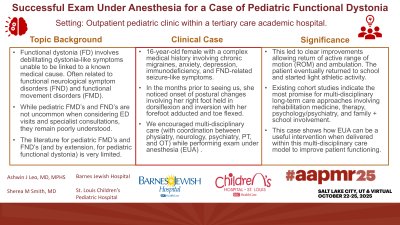
Case Diagnosis: Functional dystonia (FD) involves debilitating dystonia-like symptoms unable to be linked to a clearly known medical cause in spite of extensive work-up. It is often linked to functional neurological symptom disorders (FND) and functional movement disorders (FMD).
Case Description or Program Description: 16-year-old female with a medical history involving longstanding migraines, anxiety, depression, immunodeficiency, and various recent FND-related symptoms requiring visits to multiple specialists. Within the prior few months, she had also noticed abrupt onset of postural changes involving her right foot held in dorsiflexion and inversion with her forefoot adducted and toe flexed. Her history, work-up, and exam all pointed to FD.
Setting: Outpatient pediatric physiatry clinic within a tertiary care academic hospital.
Assessment/Results: We encouraged ongoing multi-disciplinary care (with coordination between physiatry, neurology, psychiatry, physical therapy (PT), and occupational therapy (OT)) while performing exam under anesthesia (EUA). This led to post-exam improvements allowing return of active range of motion (ROM) and subsequent ambulation. At follow-up several weeks later, the patient had returned to school and was living an active life.
Discussion (relevance): The state of literature for pediatric FMD’s and FND’s (and by extension, for a subset like FD) is very limited. Existing cohort studies indicate the most promise for multi-disciplinary care approaches involving medical rehabilitation, PT, OT, psychology/psychiatry services, and family + school assistance, with some reports of exam under anesthesia (EUA) as a therapeutic option. Our case showed EUA playing a significant role in alleviating symptoms.
Conclusions: This case builds on the limited existing evidence base for pediatric FD. It re-iterates the importance of coordinated multi-disciplinary care while demonstrating how EUA can be a useful intervention when delivered within this care model to improve patient functioning and enhance recovery from FD.

.jpg)