Attending Physician Shirley Ryan AbilityLab Chicago, Illinois
Disclosure(s):
Jacqueline Dargan, MD: No financial relationships to disclose
Case Diagnosis: A 53-year-old male with spastic paraplegia due to Multiple Sclerosis (MS) with an intrathecal baclofen pump (ITBP).
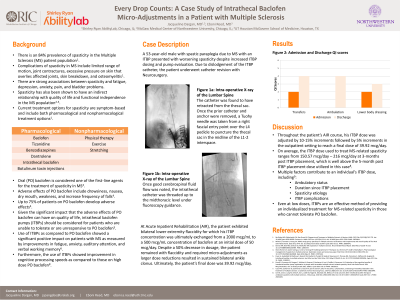
Case Description or Program Description: The patient presented with worsening spasticity despite increased ITBP dosing and pump evaluation. Further investigation revealed mispositioning of the ITBP catheter for which the patient underwent catheter replacement with Neurosurgery. The ITBP was emptied and refilled with baclofen at a concentration of 2000 mcg/mL with an initial dose of 96.3 mcg/day. At AIR, the patient exhibited bilateral lower extremity flaccidity for which his ITBP concentration was ultimately exchanged for a 500 mcg/mL concentration of baclofen at an initial dose of 50 mcg/day. Despite a 50% decrease in dosage, the patient remained with flaccidity and required micro-adjustments as larger dose reductions resulted in sustained bilateral ankle clonus. Ultimately, the patient’s final dose was 39.92 mcg/day.
Assessment/Results: At discharge from AIR, the patient progressed from ‘maximal assistance’ to ‘minimal assistance’ in transfers and ‘unable to complete’ to ‘minimal assistance’ in ambulation while using a rolling walker and left ankle-foot-orthotic. Following AIR, the patient completed 8 sessions of outpatient physical therapy and occupational therapy where he advanced to ‘contact guard assistance’ in transfers and ambulation. Furthermore, the patient demonstrated better gait patterns and ambulated 240 feet in 5 minutes as compared to 2 minutes during his initial evaluation.
Discussion (relevance): In a systematic review by Cozzi et al., the average ITBP dose to treat MS-related spasticity was 150.57 mcg/day at 3 months post ITBP placement, which is well above the 5-month post ITBP placement dose utilized in this case. Multiple factors contribute to an individual’s effective ITBP dose, including ambulatory status, duration since ITBP placement, spasticity etiology and ITBP complications.
Conclusions: Even at low doses, ITBPs are an effective method of providing an individualized treatment for MS-related spasticity in those who cannot tolerate oral baclofen.

.jpg)