Michael Boulis: No financial relationships to disclose
Background and/or Objectives: SGLT2 inhibitors act at the renal proximal tubule, diverting filtered glucose from reabsorption to excretion and thereby lowering systemic glucose availability. In excitable tissues, this metabolic shift constrains neuronal energy supply, dampening synaptic activity and reducing transmission along motor pathways. If a drug disrupts the metabolic substrate that sustains aberrant firing in spasticity, it may delay or prevent the clinical need for escalation to agents like baclofen, tizanidine, or invasive interventions. We tested whether SGLT2 inhibitors reduce the risk of advancing spasticity management in adults with motor hyperexcitability.
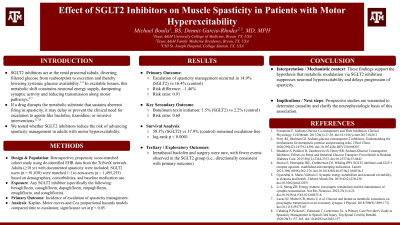
Design: Retrospective, propensity score-matched cohort study using de-identified electronic health record data from the TriNetX database.
Setting : Multi-institutional database analysis.
Participants : Cohorts comprised adults (≥ 18 years) with clinically documented spasticity who were prescribed SGLT2 inhibitors (n = 91,030) and matched controls who did not receive SGLT2 inhibitors (n = 1,495,255). The following SGLT2 inhibitors were included: bexagliflozin (Brenzavvy), canagliflozin (Invokana), dapagliflozin (Farxiga), empagliflozin (Jardiance), ertugliflozin (Steglatro), and sotagliflozin (Inpefa).
Interventions: Not applicable
Main Outcome Measures: Time to first escalation of spasticity management, defined as new prescription of targeted agents or procedures.
Results: Among 60,311 SGLT2-exposed and 61,341 matched controls, pharmacologic escalation occurred in 14.9% versus 16.4% (risk difference, –1.46%; risk ratio, 0.91). Botulinum toxin initiation was less frequent with SGLT2 exposure (1.5% vs 2.2%; risk ratio, 0.68). At the end of follow-up, 58.3% of SGLT2 users and 37.9% of controls had not required escalation (log-rank p< 0.0001). Intrathecal baclofen and surgical interventions were rare, with fewer events observed in the SGLT2 group.
Conclusions: SGLT2 inhibitor use was independently associated with reduced risk and delayed need for escalation of spasticity management in adults with motor hyperexcitability.

.jpg)