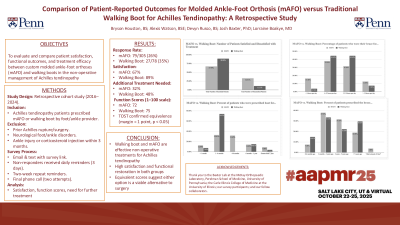
Comparison of Patient-Reported Outcomes for Molded Ankle-Foot Orthosis (mAFO) versus Traditional Walking Boot for Achilles Tendinopathy: A Retrospective Study
Medical Student University of Pennsylvania Philadelphia, Pennsylvania
Disclosure(s):
Bryson Houston, Other: No financial relationships to disclose
Background and/or Objectives: Treating Achilles tendinopathy remains a challenge for providers due to lack of consensus regarding optimal patient-centered treatment protocol. Available treatment options include physical therapy, analgesics, immobilization, and surgery. Common non-operative management includes immobilization via tall CAM walker boot (walking boot) and less commonly, use of custom molded ankle-foot orthoses (mAFO). This study aims to identify the level of patient satisfaction and treatment efficacy in using the mAFO and the walking boot for Achilles tendinopathy.
Design: Patients were identified by ICD-10 codes and prescription for a mAFO or walking boot by an orthopaedic foot and ankle provider between 2016 and 2024. After collection of patient information, surveys regarding satisfaction, functionality, and treatment course were sent to patients prescribed a mAFO or a walking boot for Achilles tendinopathy.
Setting : Retrospective Survey Study
Participants : Patients with Achilles tendinopathy
Interventions: Molded Ankle Foot Orthosis vs. CAM Walking boot
Main Outcome Measures: Patient Satisfaction and Functional scores
Results: Fifty (63%) mAFO and 16 (59%) walking boot patients reported treatment interventions prior to immobilization. Fifty-three (67%) mAFO and 24 (89%) walking boot patients were “satisfied” with their treatment. The mean Achilles tendon function rating score was 72 in the mAFO group and 75 in the walking boot group on a scale of 1 (nonfunctional) to 100 (completely functional), with the TOST procedure confirming equivalence within an equivalence margin of 1 (lower t = 0.2944, upper t = 0.6395, t-critical = 1.660, df = 101, α = 0.05).
Conclusions: Both the mAFO and the walking boot are acceptable non-operative treatment options for Achilles tendinopathy as both demonstrate a high level of patient satisfaction, restoration of acceptable functional status, and reduction in the need of additional treatment after completing their prescribed immobilization course. These non-surgical options can be valuable for patients with Achilles tendinopathy who either prefer to defer surgery or are not suitable surgical candidates.

.jpg)