Section Chief, PM&R Virginia Tech Carilion School of Medicine Roanoke, Virginia
Disclosure(s):
Justin Weppner, DO: No financial relationships to disclose
Background and/or Objectives: Effective multidisciplinary teamwork is vital in Physical Medicine and Rehabilitation (PM&R) to optimize patient care, yet reliable tools to assess and strengthen trainees' interprofessional collaboration skills are lacking.
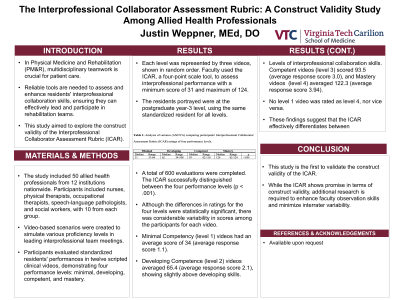
Design: This study used video scenarios to assess the construct validity of the ICAR in distinguishing interprofessional collaboration skills. Twelve scripted videos featured a standardized resident demonstrating four performance levels, each level represented by three videos in random order.
Setting : Academic Quaternary Care Centers
Participants : The study included 50 allied health professionals from 12 institutions nationwide. Participants included nurses, physical therapists, occupational therapists, speech-language pathologists, and social workers, with 10 from each group.
Interventions: The intervention used the ICAR to assess a simulated PM&R resident's interprofessional collaboration skills through video scenarios.
Main Outcome Measures: The primary outcome measure of this study is the construct validity of the ICAR, assessed by its ability to differentiate between four performance levels (minimal, developing, competent, mastery) in interprofessional collaboration skills observed in video scenarios.
Results: A total of 600 evaluations were completed. The ICAR effectively differentiated between the four performance levels (p < .0001). Although statistically significant differences were observed, there was notable variability in ratings for each video. Minimal Competency (level 1) videos had a mean score of 34.1, Developing Competence (level 2) averaged 62, Competent (level 3) scored 93.48, and Mastery (level 4) averaged 122.25. No level 1 video received a level 4 rating, and vice versa. There was no statistical difference in ratings across allied health professional specialties. These findings suggest that the ICAR can effectively distinguish interprofessional collaboration skill levels, enabling targeted training and feedback.
Conclusions: This study is the first to examine the ICAR's construct validity with allied health professionals. While the ICAR shows potential, further research is needed to enhance observational skills and reduce interrater variability. The ICAR may provide valuable feedback to PM&R residents on interprofessional collaboration skills.

.jpg)