Resident Physician HonorHealth PM&R Program Scottsdale, Arizona
Disclosure(s):
Ian Villescas, DO: No financial relationships to disclose
Case Diagnosis: Radiation-induced radiculopathy.
Case Description or Program Description: A 77-year-old male diagnosed with squamous cell carcinoma (SCC) of the left base of the tongue, treated with transoral laser microsurgery, bilateral neck dissection, and chemoradiation in 2010. A recurrence of SCC on the left lateral tongue was surgically resected in 2016, after which the patient has been disease-free. Later, the patient presented to the PM&R clinic with a 6-7 year history of intermittent bilateral upper extremity paresthesias, right greater than left.
Setting: Outpatient Cancer Rehabilitation Clinic.
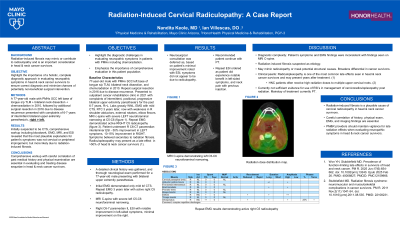
Assessment/Results: During a follow-up visit, the patient continued to experience bilateral upper extremity paresthesias and reported no improvement from hand therapy, or Botox treatments. Physical examination revealed weakness in the right arm, C5 distribution. Repeat EMG revealed active right C5 radiculopathy. MRI of the cervical spine demonstrated only left-sided neuroforaminal narrowing at C5-C6, but the patient's symptoms were predominantly right-sided, raising suspicion of radiation fibrosis as a cause for symptoms.
Discussion (relevance): The patient's symptoms and electrodiagnostic testing (EMG) initially seemed to point to carpal tunnel syndrome, but as symptoms progressed, concerns arose for cervical radiculopathy. Given the patient's history of chemoradiation for head and neck cancer, radiation-induced fibrosis became a possible contributing factor. This case highlights the importance of considering radiation effects as a cause of radicular symptoms, potentially avoiding unnecessary or inappropriate surgical interventions.
Conclusions: The patient's symptoms are likely secondary to radiation-induced fibrosis due to symptom evolution and diagnostic findings. Despite initial concerns for cervical stenosis, further investigation revealed no imaging correlation to explain the symptoms. Partial improvement observed following an epidural steroid injection helped establish neuropathic origin. This case underscores the need to consider radiation-induced complications in patients with a history of head and neck cancers to guide appropriate treatment and avoid unnecessary procedures.

.jpg)