Resident University of Kentucky College of Medicine PM&R Program Lexington, Kentucky
Disclosure(s):
Benjamin Headley, MD: No financial relationships to disclose
Case Diagnosis: The diagnostic and therapeutic complexities associated with CSF leaks following intrathecal pump implantation given that MRI was inconclusive in distinguishing between seroma and CSF leak, highlighting the necessity of beta-2 transferrin testing for definitive diagnosis
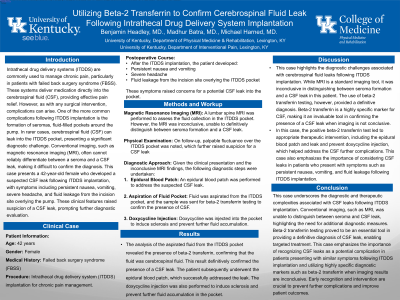
Case Description or Program Description: A 42-year-old female underwent an intrathecal pump implant, for failed back surgery syndrome. Postoperatively, she developed symptoms of nausea, vomiting, and severe headache in addition to fluid leakage from the incision site overlying the ITP, raising concerns for a CSF leak. Magnetic resonance imaging (MRI) of the lumbar spine was performed, but it could not definitively determine whether the fluid pocket was due to seroma formation or a CSF leak. Given the inconclusive MRI results and the clinical presentation, further diagnostic measures were required.
Setting: Outpatient Clinic
Assessment/Results: At a follow-up clinic appointment, a palpable fluid pocket was identified over the ITP. The patient underwent an epidural blood patch to address the suspected CSF leak. Concurrently, aspiration of the fluid pocket was performed, and the aspirate was sent for beta-2 transferrin testing, a highly specific marker for CSF. Following the aspiration, doxycycline was injected into the pump pocket to induce sclerosis and prevent further fluid accumulation.
Results: Analysis of the aspirated fluid from the patient’s pocket revealed the presence of beta-2-transferrin, confirming the fluid pocket contained CSF.
Discussion (relevance): This case underscores the diagnostic and therapeutic complexities associated with CSF leaks following intrathecal pump implantation. MRI was inconclusive in distinguishing between seroma and CSF leak, highlighting the necessity of beta-2 transferrin testing for definitive diagnosis. This case emphasizes the importance of considering CSF leaks in patients presenting with similar symptoms post-ITP implantation and utilizing the highly specific diagnostic marker, such as beta-2 transferrin, when imaging is not definitive.
Conclusions: Beta-2 transferrin has significant diagnostic utility in the setting of inconclusive MR results when differentiating CSF leak vs seroma formation

.jpg)