Resident Chang Gung Memorial Hospital, McGill University Faculty of Medicine New Taipei City, Taiwan (Republic of China)
Disclosure(s):
Yuning Peng, MD: No financial relationships to disclose
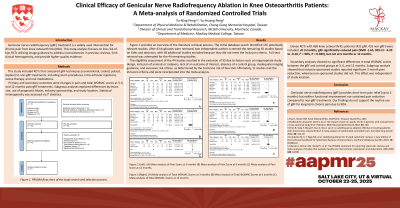
Background and/or Objectives: Genicular nerve radiofrequency ablation (gRFA) is a widely used intervention for chronic knee pain; however, evidence regarding its long-term efficacy remains inconclusive. Although several meta-analyses have evaluated the outcomes of gRFA compared to other non-surgical therapies, the included studies have varied significantly in design, as well as in their inclusion and exclusion criteria. This heterogeneity has led to inconsistent and potentially confounded results. To address these limitations, this systematic review and meta-analysis aimed to assess randomized controlled trials (RCTs) with a low risk of bias to provide high-quality evidence.
Design: Systematic Review and Meta-analysis
Setting : Medical centers at USA, Iran, China, South Korea, Egypt, and India.
Participants : Fourteen RCTs, comprising 1,034 adults with knee osteoarthritis, 520 patients received gRFA, while 514 underwent non-gRFA pain interventions.
Interventions: We identified randomized controlled trials (RCTs) comparing the effectiveness of gRFA, including both cooled and conventional RFA techniques. Non-RFA pain interventions contain: sham procedures, intra-articular steroid, lidocaine, PRP, hyaluronic acid, ozone injections, or oral medications.
Main Outcome Measures: The primary outcome was the difference in VAS and WOMAC scores between gRFA and non-RFA treatments.
Results: The gRFA resulted in a statistically significant reduction in pain scores compared to non-RFA treatments at 3 months (-1.8, 95% CI: -2.96 to -0.64, I² = 97%), but not at 6 months (-2.27, 95% CI: -5.07 to 0.52, I² = 99%) or 12 months (-1.2, 95% CI: -6.73 to 4.34, I² = 99%). Secondary analyses revealed no significant differences based on industry sponsorship or RFA modality (cooled vs. conventional).
Conclusions: The gRFA provides short-term pain relief (up to 3 months) but does not lead to sustained pain reduction or improved functional outcomes compared to non-RFA treatments. Unlike previous meta-analyses, our findings—derived from trials with a low risk of bias—do not support the routine use of gRFA for long-term knee pain management.

.jpg)








.jpg "Yuning Peng, MD photo")