Medical Student Trinity School of Medicine upper marlboro, Maryland
Disclosure(s):
Florence Odaka, MD, Other: No financial relationships to disclose
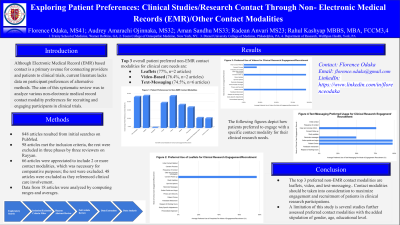
Background and/or Objectives: The aim of this systematic review was to analyze various non-electronic medical record contact modality preferences for recruiting and engaging participants in clinical trials.
Design: Systematic reviews were performed using data from original studies to gather contact modalities and statistical data of patient preferences for each of these non-EMR contact modalities.
Setting : PubMed, the Cochrane library, and the National Library of Medicine were searched for articles that addressed non-EMR contact modalities (text messages, surveys, leaflets, pamphlets, email, videos, email, and/or mail) that compared participants expressed preferences for clinical research recruitment.
Participants : Population Addressed (patients/subjects): Cancer care, Dermatology, Urology, Neuromuscular diseased, Sarcopenia, Pediatric ED, Post Menopausal Women, Army Personnel, Bariatric Surgery, Glaucoma, HIV, Hypertensive, Arthritis, Osteoporosis, Medical Abortion, etc
Interventions: Methodological quality was assessed independently by three authors using Rayyan to determine which articles should be included in this systematic review.
Main Outcome Measures: The searches retrieved a total 846 articles, of which 98 qualified for full-text screening.
Results: Sixty-six of these publications, that had two or more contact modalities addressed, were selected for further review: 18 articles focused on clinical research, 6 of the articles addressed text-messaging with 74.5% overall preference [n=6], while 77% preferred leaflets [n=2], and 76.4% preferred videos [n=2]. When examining phone calls as a contact method, an average of 49.3% participants preferred its use irrespective of the recruitment or communication strategy involved, [n=12]. Likewise, for mailing, there was a 55.3% average preference, [n=10]. Regarding patient preferences for initial contact method, 52.8% preferred its use for phone calls, while 69.5% preferred its use if by mail.
Conclusions: The top three most prevalent contact modalities for participants regarding research recruitment were leaflets, video, and text-messaging. By taking these patient preferences into account, one can create a recruitment and communication strategy that respects patients' autonomy, minimizes intrusion, and fosters a positive experience for potential study participants.

.jpg)