Medical Student MS4 Philadelphia College of Osteopathic Medicine Philadelphia, Pennsylvania
Disclosure(s):
Kazune Matsuoka, Other: No financial relationships to disclose
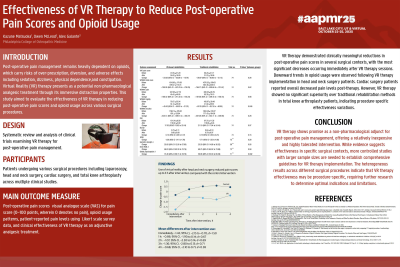
Background and/or Objectives: Post-operative pain management remains heavily dependent on opioids, which carry risks of overprescription, diversion, and adverse effects including sedation, dizziness, physical dependence, and constipation. Virtual Reality (VR) therapy presents as a potential non-pharmacological analgesic treatment through its immersive distraction properties. This study aimed to evaluate the effectiveness of VR therapy in reducing post-operative pain scores and opioid usage across various surgical procedures.
Design: Systematic review and analysis of clinical trials examining VR therapy for post-operative pain management.
Setting : Research foundation for Opioid research and Education
Participants : Patients undergoing various surgical procedures including laparoscopy, head and neck surgery, cardiac surgery, and total knee arthroplasty across multiple clinical studies.
Interventions: N/A
Main Outcome Measures: Post-operative pain scores using visual analogue scale (VAS) for pain score (0–100 points, wherein 0 denotes no pain), opioid usage patterns, patient-reported pain levels using Likert scale survey data, and clinical effectiveness of VR therapy as an adjunctive analgesic treatment.
Results: VR therapy demonstrated clinically meaningful reductions in post-operative pain scores in several surgical contexts, with the most significant decreases occurring immediately after VR therapy sessions. Downward trends in opioid usage were observed following VR therapy implementation in head and neck surgery patients. Cardiac surgery patients reported overall decreased pain levels post-therapy. However, VR therapy showed no significant superiority over traditional rehabilitation methods in total knee arthroplasty patients, indicating procedure-specific effectiveness variations.
Conclusions: VR therapy shows promise as a non-pharmacological adjunct for post-operative pain management, offering a relatively inexpensive and highly tolerated intervention. While evidence suggests effectiveness in specific surgical contexts, more controlled studies with larger sample sizes are needed to establish comprehensive guidelines for VR therapy implementation. The heterogeneous results across different surgical procedures indicate that VR therapy effectiveness may be procedure-specific, requiring further research to determine optimal indications and limitations.

.jpg)