Chief Physician Seoul Tong Orthopedic Clinic Seoul
Disclosure(s):
Sojeong Mun, MD: No financial relationships to disclose
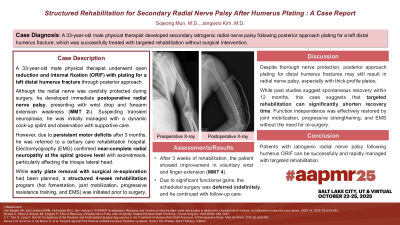
Case Diagnosis: A 33-year-old male physical therapist developed secondary iatrogenic radial nerve palsy following posterior approach plating for a distal humerus fracture, which was successfully treated with targeted rehabilitation.
Case Description or Program Description: A 33-year-old male physical therapist underwent open reduction and internal fixation (ORIF) with plating for a distal humerus fracture through a posterior approach. Despite intraoperative radial nerve protection, he developed immediate postoperative radial nerve palsy, presenting with wrist drop and forearm extension weakness graded as 1- on manual muscle testing (MMT). Suspecting transient neuropraxia, he was initially managed with a dynamic cock-up splint and observation with supportive care. However, due to persistent motor deficits after 3 months, he was referred to a tertiary care rehabilitation hospital. Electromyography (EMG) confirmed near-complete radial neuropathy at the spiral groove level with axonotmesis, particularly affecting the triceps lateral head. While early plate removal was considered, a structured 4-week rehabilitation program, including hot fomentation, joint mobilization, progressive resistance training, and electrical muscle stimulation (EMS), was initiated prior to planned re-operation.
Setting: From primary care orthopedic surgery clinic to tertiary care rehabilitation hospital
Assessment/Results: After 3 weeks, significant functional improvement, including voluntary extensor movement graded as 4 on MMT, was observed. As a result, the previously planned surgical exploration was canceled, and the patient continued with follow-up management.
Discussion (relevance): Despite careful nerve protection, posterior approach plating for distal humerus fractures can still cause radial nerve palsy, especially with thick-profile plates. While past studies suggest spontaneous recovery within 12 months, this case suggests that targeted rehabilitation can significantly shorten recovery time. Function independence was effectively restored by joint mobilization, progressive strengthening, and EMS without the need for surgical re-exploration.
Conclusions: Patients with iatrogenic radial nerve palsy following humerus ORIF can be managed with targeted rehabilitation successfully and rapidly with significant functional recovery.

.jpg)