Medical Student Burrell College of Osteopathic Medicine Apple Valley, Minnesota
Disclosure(s):
Rhea Kohli, Other: No financial relationships to disclose
Case Diagnosis: Persistent wound dehiscence and infection in a 75-year-old woman with Rheumatoid arthritis, two decades after Achilles tendon surgical repair.
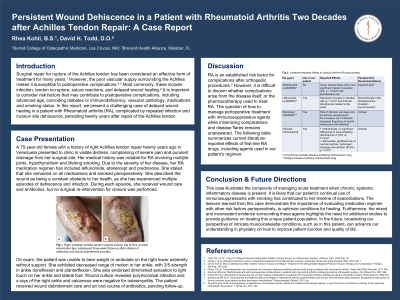
Case Description or Program Description: A 75-year-old female with Rheumatoid arthritis (RA), who underwent surgical repair of the right Achilles tendon twenty years ago in Venezuela, presented with complaints of repeated incision site dehiscence and infection. Perioperatively, she remained on immunosuppressive medications and continued smoking. She presented on exam with gross ulceration, purulent drainage and aggravating pain from the surgical site. She was unable to ambulate on the right extremity and exhibited decreased range of motion and sensation in the right ankle and foot.
Setting: Outpatient
Assessment/Results: Wound culture revealed polymicrobial infection, and x-rays showed no articular disturbance or osteomyelitis. She received wound care and antibiotics, pending follow-up.
Discussion (relevance): RA is an established risk factor for complications after orthopedic procedures. The question of how to manage perioperative treatment while minimizing complications and disease flares remains unanswered. In an analysis of first-line drugs, current data suggests mixed evidence. Methotrexate has been determined as safe, with fewer disease flares. Leflunomide, a drug in the same class, has shown an increased risk of infection and wound disturbances. Studies done on biologic drugs have shown some as safe and others increasing the risk of bleeding and dehiscence. The use of corticosteroids in combination with other RA drugs produce complications including necrotic eschars and prolonged drainage.
Conclusions: This case illustrates the complexity of managing acute treatment when chronic, systemic inflammatory disease is present. Our patient's use of immunosuppressive agents while smoking has likely contributed to her exacerbations. Furthermore, this case demonstrates the importance of evaluating medication regimen with risk factors perioperatively to optimize conditions for patient healing, function and quality of life. The mixed and inconsistent evidence surrounding these agents highlights the need for additional studies.

.jpg)