Professor, Division Chief, Program Director University of Toledo PM&R Program Toledo, Ohio
Disclosure(s):
Cody S. Paul, DO: No financial relationships to disclose
Case Diagnosis: Myxopapillary ependymoma at L2-L3 with mass effect on adjacent cauda equina nerve roots
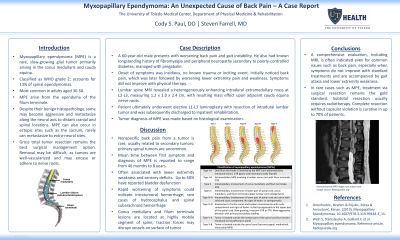
Case Description or Program Description: A 60-year-old man with worsening back pain, gait instability, and neuropathy symptoms. He had a longstanding history of fibromyalgia and peripheral neuropathy secondary to poorly controlled diabetes, managed with pregabalin. He began experiencing back pain of insidious onset, followed by worsening lower extremity pain and weakness, which did not improve with physical therapy. Lumbar spine MRI revealed a heterogeneously enhancing intradural extramedullary mass at L2-3, measuring 1.2 x 1.0 x 2.4 cm, with resulting mass effect upon adjacent cauda equina nerve roots. After optimizing his diabetes control, the patient underwent elective L1-L3 laminoplasty with resection of intradural lumbar tumor and was subsequently discharged to inpatient rehabilitation for additional therapies.
Setting: Community-based tertiary care hospital
Assessment/Results: The tumor was diagnosed as myxopapillary ependymoma based on pathological examination. Patient continued to have post-operative back pain during acute rehabilitation, but he did demonstrate functional improvement with therapies, and ultimately discharged as modified-independent for all activities.
Discussion (relevance): Back pain from a tumor is rare, with most cases caused by secondary tumors; primary spinal tumors are even more uncommon. Myxopapillary ependymoma is the most common tumor of the conus medullaris and cauda equina region of the spinal cord, described as a slow-growing benign tumor most frequently found in adults between 30-50 years of age. This case highlights the importance of a broad differential. Given his history of neuropathy and fibromyalgia, it is possible that early symptoms from the tumor may have been difficult to isolate.
Conclusions: Thorough evaluation is necessary even for common complaints like back pain, particularly when unresponsive to conventional treatment. In rare cases of myxopapillary ependymoma, surgical resection remains the primary treatment.

.jpg)