Resident, PGY-4 Ohio State University College of Medicine Columbus, Ohio
Disclosure(s):
Breanna Santoso, Other: No financial relationships to disclose
Case Diagnosis: Miller Fisher Syndrome (MFS), variant of Guillain-Barre Syndrome (GBS)
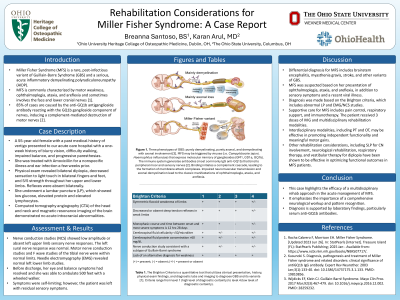
Case Description or Program Description: A 55-year-old female with a past medical history of vertigo presented to our acute care hospital with a one-week history of blurry vision, difficulty walking, impaired balance, and progressive paresthesias. She was treated with Amoxicillin for a nonspecific illness and ear infection a few weeks prior. Physical exam revealed bilateral diplopia, decreased sensation to light touch in bilateral fingers and feet, and 5/5 strength throughout her upper and lower limbs. Reflexes were absent bilaterally. She underwent a lumbar puncture (LP), which showed low glucose, elevated protein and elevated lymphocytes. Computed tomography angiography of the head and neck and magnetic resonance imaging of the brain demonstrated no acute intracranial abnormalities.
Setting: Tertiary care academic hospital
Assessment/Results: Nerve conduction studies (NCS) showed low amplitude or absent left upper limb sensory nerve responses. The left sural nerve response was normal. Motor nerve conduction studies and F wave studies of the tibial nerve were within normal limits. Needle electromyography (EMG) revealed normal left lower limb studies.
Discussion (relevance): Based on her presentation of ophthalmoplegia, ataxia, and areflexia, in addition to sensory symptoms and a recent viral illness, MFS was suspected. Diagnosis was made based on the Brighton criteria, which includes abnormal LP and EMG/NCS studies. She received 3 doses of IVIG and multidisciplinary rehabilitation modalities. Before discharge, her eye and balance symptoms had resolved and she was able to ambulate 500 feet with a wheeled walker. Interdisciplinary modalities, including PT, OT, SLP, neurological rehabilitation, respiratory therapy, and vestibular rehabilitation have been shown to be effective in optimizing functional outcomes in MFS patients.
Conclusions: This case highlights the efficacy of a multidisciplinary rehab approach in the acute management of MFS.

.jpg)