Resident Indiana University School of Medicine PM&R Program Indianapolis, Indiana
Disclosure(s):
Kennedy Nies, DO: No financial relationships to disclose
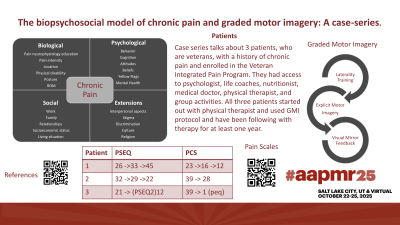
Case Diagnosis: Patients referred to VA Active Management of Pain program for having pain greater than 6 months, used graded motor imagery as modality in initial physical therapy sessions to help with decentralization of pain.
Case Description or Program Description: In these cases the biopsychosocial model of treating chronic pain using a multidisciplinary approach, including physical therapy. The patients had high pain catastrophizing scale and low pain self efficacy questionnaire scores, limiting daily functions. In these cases, pain was so bad that physical therapy was limited. The therapist started with graded motor imagery to help with decentralization of pain.
Setting: Patients referred to VA Pain program for refractory chronic pain, that used graded motor imagery in initial physical therapy sessions.
Assessment/Results: After graded motor imagery, patients were able to have functional gains and decrease pain to be able to progress with physical therapy. Patients were able to live more active lifestyles. In all cases, pain catastrophizing scale was decreased and pain self efficacy questionnaire scores were increased.
Discussion (relevance): One in five adults live with chronic pain in the United States. There have been studies that show chronic pain can lead to central sensitization. GMI has been proven to help with decentralization of pain. Graded Motor Imagery can last weeks and would rely on patients to have a robust home exercise program so that they could make gains prior to sessions If physicians are able to educate patients on this modality, with a home exercise program, patients would be able to have head start.
Conclusions: Graded motor imagery, with teaching of biopsychosocial model of treating pain, has been shown to be beneficial in decreasing patients' pain enough for them to work towards more advanced strengthening and becoming more functional in their daily life. Patients were able to demonstrate better functional outcomes as well as have a decrease in perceived pain.

.jpg)








.jpg "Kennedy Nies, DO photo")