PGY2 Tower Health PM&R Program Lebanon, Pennsylvania
Disclosure(s):
Stephen Chien, Other: No financial relationships to disclose
Larry Osborne, MS DO: No financial relationships to disclose
Case Diagnosis: Ischemic infarct of the right cortical hand knob region
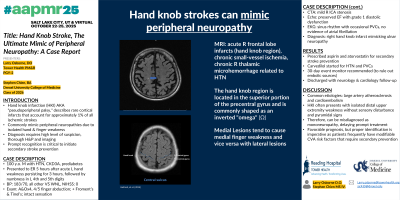
Case Description or Program Description: A 100 year old male with a history of untreated hypertension, chronic kidney disease 3A, and prediabetes presented to the hospital 5 hours after symptom onset with acute left hand weakness and numbness. Symptoms began the night prior with sudden left-hand motor loss lasting 3 hours, followed by numbness in the left 4th and 5th digits. Initial blood pressure was 183/70 and NIHSS was 0.
The patient was alert and fully oriented, with ⅘ strength in the left deltoid and finger abduction. Froment’s and Tinel’s sign over Guyon’s canal were positive, Spurling’s was negative, left pronator drift was observed, and intact sensation. Computed tomography angiography showed mild right internal carotid artery stenosis. Magnetic resonance imaging revealed acute cortical infarcts in the right frontal lobe consistent with the hand knob region. Echocardiogram showed preserved ejection fraction with grade 1 diastolic dysfunction. Electrocardiogram showed sinus rhythm with occasional premature ventricular contractions (PVCs).
Setting: Acute care hospital
Assessment/Results: The patient was prescribed aspirin and atorvastatin for secondary stroke prevention. Carvedilol was started for blood pressure control and PVCs, a 30-day event monitor was recommended to evaluate for embolic sources, and he was discharged with cardiology and neurology follow-ups.
Discussion (relevance): Hand knob strokes present with unilateral motor weakness of the hand, distal arm, or fingers with or without paresthesia. This condition can be misdiagnosed as a peripheral mononeuropathy without a high level of suspicion and a thorough history and physical exam. Although hand knob strokes have a favorable prognosis, prompt diagnosis and secondary prevention is imperative as these patients commonly possess risk factors for future cerebrovascular accident (CVA).
Conclusions: Hand knob strokes account for approximately 1% of all ischemic strokes. Although uncommon, prompt diagnosis and appropriate treatment remains imperative to optimize functional outcomes and decrease risk of future CVA.

.jpg)