Clinical Instructor of Physical Medicine and Rehabilitation Cleveland Clinic Westlake, Ohio
Case Diagnosis: Extracorporeal shockwave therapy (ESWT) improves persistent graft harvest site pain following anterior cruciate ligament (ACL) reconstruction surgery
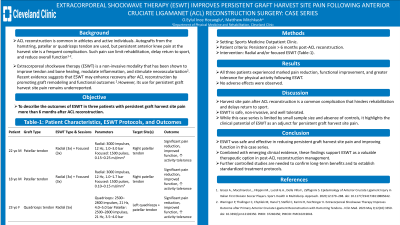
Case Description or Program Description: Four patients with persistent moderate to severe graft harvest site pain more than 6 months after ACL reconstruction surgery underwent ESWT.
Setting: Sports Medicine Outpatient Clinic
Assessment/Results: The first patient with a patellar tendon autograft received three sessions of both radial (3000 impulses, 12 Hz, 1.0-3.0 bar) and focused (1500 pulses, 0.15-0.25 mJ/mm²) shockwave therapy targeting the right patellar tendon. The second patient with a patellar tendon graft received three sessions of both radial (3000 impulses, 12 Hz, 1.0-1.7 bar) and focused (1500 pulses, 0.10-0.15 mJ/mm²) shockwave therapy targeting the right patellar tendon. The third patient with a patellar tendon graft received three sessions of focused (2000 pulses, 0.10-0.20 mJ/mm²) shockwave therapy targeting the left patellar tendon. The fourth patient with a quadriceps tendon graft received five sessions of radial shockwave therapy targeting the left quadriceps tendon and left patellar tendon, with a total of 2500-2800 impulses (21 Hz, 4.0-5.0 bar for the quadriceps tendon and 21 Hz, 3.5-4.0 bar for the patellar tendon). All patients reported significant pain reduction, improved function, and increased tolerance for physical activity. No adverse effects were reported.
Discussion (relevance): Post-operative anterior knee/graft harvest site pain is common and can significantly impact recovery and delay return to sport. ESWT is a promising treatment option for graft harvest site pain, but there is limited research on its use for this indication. This case series demonstrated that ESWT effectively reduced pain and helped accelerate functional recovery within one year, suggesting that it is a potentially effective adjunctive treatment for graft harvest site pain.
Conclusions: This case series highlights ESWT as a potential therapeutic addition to the management of graft harvest site pain after ACL reconstruction.

.jpg)