Assistant Professor Aileen Giordano MD Crozet, Virginia
Disclosure(s):
Jacob K. Goforth, MD: No financial relationships to disclose
Case Diagnosis: A 71-year-old female pianist with apraxia of eyelid opening (AEO) after tip of the basilar artery aneurysm rupture status-post coiling.
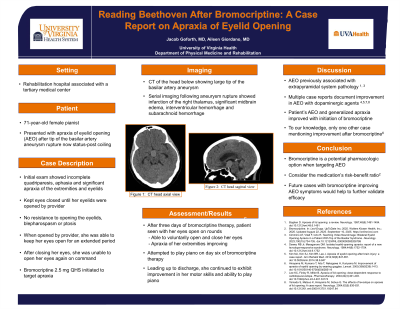
Case Description or Program Description: Imaging following her basilar artery rupture displayed infarction of the right thalamus, significant midbrain edema and subarachnoid hemorrhage. On initial exam by our team, the patient exhibited incomplete quadriparesis, aphasia and significant apraxia of the extremities and eyelids. She kept her eyes closed on exam until her eyelids were opened by the provider. No resistance to opening the eyelids, blepharospasm or ptosis was present. After being opened, she was able to keep her eyes open for an extended period. Following voluntary closure, she was unable to open her eyes again on command. Bromocriptine 2.5 mg QHS was started as pharmacotherapy to target the patient’s apraxia.
Setting: Rehabilitation hospital associated with tertiary medical center
Assessment/Results: After three days of bromocriptine therapy, the patient was seen with her eyes wide open on rounds. She displayed the ability to both voluntarily close and open her eyes without assistance. Her apraxia of speech and apraxia of her extremities also began to show gradual improvement. On day six of bromocriptine administration, the patient attempted to play piano during her therapy session. She continued to exhibit improvement in her motor skills and ability to play piano leading up to discharge.
Discussion (relevance): AEO is a rare condition that has been witnessed in association with extrapyramidal system pathology. Multiple case reports in the literature document improvement in AEO after administration of dopaminergic agents. However, this is only the second reported case, to our knowledge, showing improvement after the initiation of bromocriptine.
Conclusions: Our patient exhibited improvement in AEO after initiation of bromocriptine therapy. Based upon the results in this case, bromocriptine could be considered as a potential pharmacologic option when targeting AEO.

.jpg)