Associate Professor University of Toledo PM&R Program Monclova, Ohio
Disclosure(s):
Angelika Urbaniak, MD: No financial relationships to disclose
Case Diagnosis: 62-year-old female with chronic right shoulder pain, presenting with worsening pain and swelling over her acromioclavicular (AC) joint, was found to have an AC joint ganglion cyst with geyser sign in the setting of complete supraspinatus and infraspinatus tears.
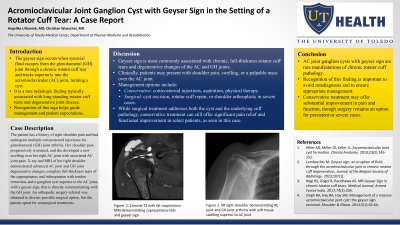
Case Description or Program Description: The patient has a history of right shoulder pain and had undergone multiple corticosteroid injections for glenohumeral (GH) joint arthritis. Her shoulder pain progressively worsened, and she developed a new swelling over her right AC joint with associated AC joint pain. X-ray and MRI of her right shoulder demonstrated advanced AC joint and GH joint degenerative changes, complete full-thickness tears of the supraspinatus and infraspinatus with tendon retraction, and a ganglion cyst superior to the AC joint, with a geyser sign, that is directly communicating with the GH joint. An orthopedic surgery referral was obtained to discuss possible surgical option, but the patient opted for nonsurgical treatments.
Setting: Outpatient Physical Medicine and Rehabilitation Clinic
Assessment/Results: As patient opted for conservative treatment, corticosteroid injections were performed into the AC joint and GH joint. Patient reported significant improvement in pain and function.
Discussion (relevance): A geyser sign is a rare finding on MRI or ultrasound, indicating communication between the glenohumeral joint and a superiorly extruding cyst above the AC joint due to a chronic rotator cuff tear and degenerative AC joint changes. Management options can range from conservative treatments, including physical therapy, aspiration, and joint injections, to surgical interventions, such as cyst excision and rotator cuff repair.
Conclusions: AC joint ganglion cysts with geyser sign are associated with chronic rotator cuff tears. While surgical options may be definitive, conservative treatments can provide substantial symptomatic relief.

.jpg)