Chief, Cancer Rehabilitation Miami Cancer Institute Coral Gables, Florida
Disclosure(s):
Max Farson, Other: No financial relationships to disclose
Case Diagnosis: Adhesive capsulitis of the left shoulder and lymphedema secondary to radiation-induced extraskeletal osteosarcoma (RIEO).
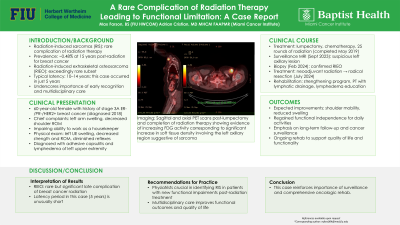
Case Description or Program Description: A 60-year-old female with a history of stage 3A ER-/PR-/HER2+ breast cancer presented to the cancer rehabilitation clinic with left arm swelling and decreased shoulder range of motion (ROM). She underwent left lumpectomy, chemotherapy, and radiation therapy in 2018. Surveillance MRI in 2023 revealed a left axillary mass, later confirmed as RIEO. Following neoadjuvant radiation, she had a radical resection of the sarcoma. In the cancer rehab clinic, the patient reported a several month history of progressive left arm weakness, swelling, and functional impairment, limiting her ability to work as a housekeeper. Examination revealed swelling, reduced strength, limited ROM, and diminished deep tendon reflexes in the left upper extremity. She was diagnosed with adhesive capsulitis and lymphedema. Initial treatment recommendations included education on a home exercise program and referral to physical therapy for improving shoulder ROM and strength and manual lymphatic drainage program.
Setting: Outpatient cancer rehabilitation clinic
Assessment/Results: The patient is currently undergoing rehabilitation program.
Discussion (relevance): Radiation-induced sarcomas are a rare complication of breast cancer treatment, with a 0.48% prevalence at 15 years. RIEO is exceedingly rare, with few reported cases. While the latency for RIEO is typically 10-14 years, this case demonstrated a latency of only five years. These rare conditions can profoundly impact function and quality of life, requiring prompt diagnosis and coordination of care.
Conclusions: Physiatrists play a vital role in managing functional impairments associated with cancer complications like RIEO. Physiatrists should consider RIEO in the differential diagnosis of breast cancer patients presenting with new upper extremity functional impairments years following completion of radiation treatment. A multidisciplinary approach is critical for improving outcomes and restoring quality of life in this population.

.jpg)