Resident Physician University of Kentucky College of Medicine PM&R Program Lexington, Kentucky
Disclosure(s):
Augusta Kiepper, DO: No financial relationships to disclose
Case Diagnosis: Phantom limb pain improvement s/p DRG implantation
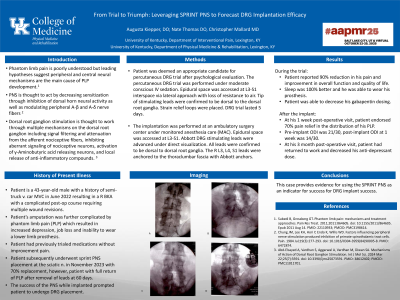
Case Description or Program Description: Patient is a 43 y.o. year old male with a history of a R BKA with a post-op course complicated by multiple wound revisions. His amputation was further complicated by phantom limb pain (PLP) and subsequently underwent SPRINT PNS placement along the sciatic nerve after failure of oral medications and therapies. Patient had significant improvement in his PLP, however, after lead removal his PLP returned. Due to the prior success, patient decided to proceed with DRG trial.
Setting: Outpatient
Assessment/Results: For the trial the DRG lead was placed at R L3, L4 and S1 with greater than 50% relief during the trial. Patient elected to proceed with implantation. Implantation was placed at the same location as the trial. At 1-week follow up, patient had greater than 70% pain relief in the appropriate distribution. Patient’s ODI at pre-implant was 21/30 and post-implant was 14/30. At 3 months post implantation, patient had returned to work and decreased his anti-depressant dosage.
Discussion (relevance): Peripheral nerve stimulation is a therapeutic technique that involves the delivery of electrical impulses to peripheral nerves to modulate pain perception and promote neuromodulation. The process involves the implantation of a small lead near the target nerve, which can be placed percutaneously. The electrical impulses alter the nerve’s activity, either by disrupting pain signals traveling to the brain, through the "gate control theory" of pain modulation, or by inducing neuroplastic changes that reduce the long-term perception of pain. DRG stimulation is thought to work through multiple mechanisms on the dorsal root ganglion including signal filtering and attenuation from the afferent nociceptive fibers, inhibiting aberrant signaling of nociceptive neurons, activation of γ-Aminobutyric acid releasing neurons, and local release of anti-inflammatory compounds.
Conclusions: This case demonstrates the possible use of PNS success as a predictor for DRG implantation success rates.

.jpg)