Medical Student University of North Texas HSC Fort Worth Texas College of Osteopathic Medicine San Antonio, Texas
Disclosure(s):
Dean Hatzenbiler: No financial relationships to disclose
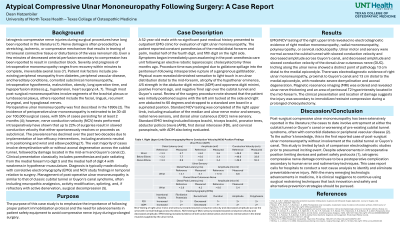
Case Diagnosis: A 52-year-old male with atypical right ulnar mononeuropathy secondary to prolonged compression during complicated cholecystectomy.
Case Description or Program Description: The patient reports constant numbness and tingling in the medial palm, medial half of digit four, and digit five on the right side since awakening in the post-anesthesia care unit following an elective laparoscopic cholecystectomy three months ago. Intraoperative time was prolonged due to gallstone spillage into the peritoneum following rupture of a necrotic gallbladder wall. Physical exam reveals diminished sensation to light touch over the affected area, hypothenar eminence atrophy, ⅘ strength in the abductor digiti quinti and opponens digiti quinti, and a negative Tinel’s sign over the cubital tunnel and Guyon’s canal. Electromyography (EMG) and nerve conduction velocity (NCV) tests of the right upper extremity are performed and show normal findings across the cubital tunnel, slowed conduction velocity and decreased amplitude across the Guyon’s canal, and decreased dorsal ulnar cutaneous nerve amplitude and slowed conduction velocity.
Setting: Outpatient clinic.
Assessment/Results: Clinical presentation and EMG/NCV findings suggest right ulnar mononeuropathy, proximal to Guyon’s canal and distal to the cubital tunnel, with moderate-severe demyelination and axonal degeneration secondary to surgical restraint compression.
Discussion (relevance): Post-surgical compressive ulnar mononeuropathy has been extensively reported in the literature. The cases to date involve entrapment of the ulnar nerve at either the cubital tunnel or Guyon’s canal, the two most common sites of non-traumatic ulnar nerve injury. Cases have also been reported of post-surgical worsening of pre-existing cubital tunnel syndrome. To the author’s knowledge, this is the first reported case of post-surgical ulnar mononeuropathy without involvement at the cubital tunnel or Guyon’s canal.
Conclusions: Despite patient safety advancements in surgical equipment, adverse events from prolonged surgical compression continue to occur. Further quality improvement projects designed to eliminate the risk of human error and implement forcing functions in the application of restraints are necessary.

.jpg)