postdoctoral research associate Washington University in St. Louis SAINT LOUIS, Missouri
Disclosure(s):
Chengchong Ai, MD, PhD: No financial relationships to disclose
Background and/or Objectives: Osteoarthritis (OA) is an increasingly widespread condition that imposes a substantial socioeconomic burden globally. Extensive research has been undertaken to elucidate the mechanisms underlying OA, with the aim of advancing treatment strategies for osteoarthritis. Our previous research established the involvement of Dnmt3b/Abat axis in the progression of OA, demonstrating the Dnmt3b suppression and subsequent Abat upregulation contribute to the advancement of OA. In this study, we aimed to investigate the effect of intra-articular inhibition of Abat in a murine OA model.
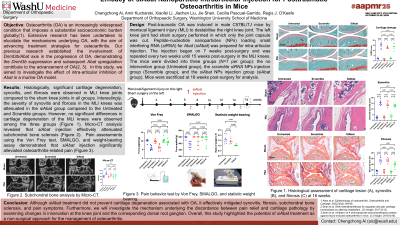
Design: Post-traumatic OA was induced in male C57BL/7J mice by meniscal ligament injury (MLI) to destabilise the right knee joint. The left knee joint underwent sham surgery. Peptide-nucleotide nanoparticles (NPs) loading small interfering RNA (SiRNA) for Abat (SiAbat) was prepared for intra-articular injection. The mice were divided into three groups: the no intervention group (Untreated group), the scramble siRNA NPs injection group (Scramble group), and the siAbat NPs injection group (SiAbat group).
Main Outcome Measures: Histology, micro-CT, and pain measurement
Results: Histologically, significant cartilage degeneration, synovitis, and fibrosis were observed in MLI knee joints compared to the sham knee joints in all groups. Interestingly, the severity of synovitis and fibrosis in the MLI knees was attenuated in the SiAbat group compared to the Untreated and Scramble groups. However, no significant differences in cartilage degeneration of the MLI knees were observed among the three groups. Micro-CT analysis revealed that SiAbat injection effectively attenuated subchondral bone sclerosis. Pain assessments using the Von Frey test, SMALGO, and weight-bearing assay demonstrated that SiAbat injection significantly alleviated osteoarthritis-related pain.
Conclusions: These findings indicated that, although SiAbat treatment did not prevent cartilage degeneration associated with OA, it effectively mitigated synovitis, fibrosis, subchondral bone sclerosis, and pain symptoms.

.jpg)