postdoctoral research associate Washington University in St. Louis SAINT LOUIS, Missouri
Disclosure(s):
Chengchong Ai, MD, PhD: No financial relationships to disclose
Background and/or Objectives: Tissue engineering offers potential solutions for restoring or enhancing the function of damaged tissues, which is central to the goals of rehabilitation. Tissue engineering methods, such as creating bioengineered cartilage or using stem cells for cartilage regeneration, can provide long-term solutions for joint repair. This study aims to manufacture an osteochondral construct in vitro, providing a platform for testing biomaterials or regenerative therapies that may be used for joint repair.
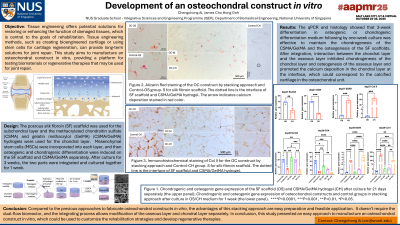
Design: The porous silk fibroin (SF) scaffold was used for the subchondral layer and the methacrylated chondroitin sulfate (CSMA) and gelatin methacrylol (GelMA) (CSMA/GelMA) hydrogels were used for the chondral layer. Mesenchymal stem cells (MSCs) were incorporated into each layer, and then osteogenic and chondrogenic differentiation were induced on the SF scaffold and CSMA/GelMA separately. After culture for 3 weeks, the two parts were integrated and cultured together for 1 week.
Setting : The experiment was conducted in a controlled laboratory setting.
Participants : Mesenchymal stem cells
Interventions: Porous scaffolds and hydrogels
Main Outcome Measures: The osteogenic and chondrogenic performance
Results: The qPCR and histology showed that 3-week differentiation in osteogenic or chondrogenic differentiation medium following by one-week culture was effective to maintain the chondrogenesis of the CSMA/GelMA and the osteogenesis of the SF scaffolds. After integration, interaction between the chondral layer and the osseous layer inhibited chondrogenesis of the chondral layer and osteogenesis of the osseous layer and promoted the calcium deposition in the chondral layer at the interface, which could correspond to the calcified cartilage in the osteochondral unit.
Conclusions: In conclusion, this study presented an easy approach to manufacture an osteochondral construct in vitro, which could be used to customise the rehabilitation strategies and develop regenerative therapies.

.jpg)